The UK Money Laundering Regulations for Accountancy and Legal Firms: What Has to Be in Place
The Money Laundering, Terrorist Financing and Transfer of Funds (Information on the Payer) Regulations 2017, usually just the MLRs, apply to accountancy service providers, trust and company service providers, tax advisers, independent legal professionals and several other sectors. The regulations are long. The obligations that matter to a professional firm fit on a page, and that page is what a supervisory visit works through.
This is a practical summary for firm owners and compliance officers. It is not legal advice, and your supervisor's guidance, together with the sector guidance approved by HM Treasury, is the reference.
Key takeaways
- One set of regulations, many supervisors. Professional bodies supervise their members, HMRC supervises the rest, the SRA and its equivalents supervise lawyers, and OPBAS oversees the professional bodies.
- Five documents every firm must be able to produce: the firm-wide risk assessment, written policies and procedures, the training record, client due diligence files and the internal suspicious activity report log.
- Enhanced due diligence is mandatory for politically exposed persons, high-risk third countries and anything the firm's own assessment rates high, with source of wealth and senior approval recorded.
- Records are kept five years after the relationship ends, in a form that lets the file be reconstructed.
Who supervises you
Accountancy firms are supervised by their professional body where they have one: ICAEW, ACCA, CIOT, AAT and the others. Firms without a professional body supervisor, including many bookkeepers and trust and company service providers, are supervised by HMRC and must register with it before trading. Solicitors in England and Wales are supervised by the Solicitors Regulation Authority, with equivalents in Scotland and Northern Ireland. The Office for Professional Body AML Supervision oversees the professional bodies themselves, which is why their inspections have become noticeably more consistent and more demanding.
A firm that provides accountancy services and company formation can be supervised by its professional body for both, but should check, because trust and company service work has its own registration requirements.
The firm-wide risk assessment
Regulation 18 requires every firm to produce and keep up to date a written assessment of its own money laundering risk, taking into account its customers, the countries it deals with, its products and services, its transactions and its delivery channels. The assessment has to reflect the national risk assessment and the supervisor's guidance, and it has to be available to the supervisor on request.
This document is the foundation of everything else. The client risk ratings, the level of due diligence and the review frequencies all have to be justified by reference to it. The most common finding on first inspections is that it does not exist or that it was written once and never revisited.
Policies, controls and procedures
Regulation 19 requires written policies, controls and procedures proportionate to the firm's size and nature, covering risk management, customer due diligence, reporting, record keeping, monitoring and the internal communication of those policies. They must be approved by senior management and reviewed regularly. Regulation 21 adds, for firms above a size threshold, a nominated officer, an officer responsible for compliance, screening of relevant employees and an independent audit function.
The nominated officer
Every firm appoints a nominated officer, usually called the MLRO, who receives internal reports of suspicion and decides whether to submit a suspicious activity report to the National Crime Agency. The MLRO needs authority, time and access. A firm where the MLRO is a junior with no visibility of the client base has an MLRO on paper only.
Training
Regulation 24 requires relevant employees to be made aware of the law and trained in recognising and dealing with suspicious activity, with records kept of what training was given and when. The requirement is ongoing, not one-off.
Customer due diligence
Regulations 27 and 28 set out when due diligence is required and what it consists of. Before establishing a business relationship or carrying out an occasional transaction above the threshold, the firm identifies the customer and verifies their identity from a reliable independent source, identifies and verifies the beneficial owners, and understands the purpose and intended nature of the relationship. For a company that means the directors, the owners above 25 percent and anyone else who controls it, with the senior managing official as a fallback where no owner can be identified.
Due diligence is repeated at appropriate times during the relationship and whenever the firm becomes aware of a relevant change. Regulation 28 also requires the firm to take reasonable measures to understand the ownership and control structure of a corporate customer, which in practice means drawing the chart.
Enhanced due diligence
Regulation 33 requires enhanced measures where the risk is higher, and in particular for transactions or relationships involving high-risk third countries, for politically exposed persons under Regulation 35, for complex or unusually large transactions and in any case where the firm's own assessment indicates high risk. Enhanced measures include obtaining additional information on the customer and the beneficial owners, establishing the source of funds and source of wealth, senior management approval and increased monitoring. For politically exposed persons the firm must also take adequate measures to establish source of wealth and funds, and continue enhanced monitoring for at least twelve months after they leave office.
Reliance and outsourcing
A firm may rely on due diligence performed by another regulated person, but it remains liable for any failure. Most supervisors expect the firm to hold copies of the underlying evidence rather than a confirmation letter. Where identity verification is outsourced to an electronic provider, the firm needs to understand what the check covers and keep the result.
Record keeping
Regulation 40 requires the firm to keep copies of the due diligence documents and the supporting records for five years after the end of the business relationship or the completion of the occasional transaction. Records must be sufficient to allow the transaction to be reconstructed and to show the firm complied. In practice the test is whether a closed file from four years ago can be produced with its identification documents, its ownership chart, its risk assessment and its screening evidence.
Suspicious activity reports
Where an employee knows or suspects, or has reasonable grounds to know or suspect, that another person is engaged in money laundering, they report internally to the nominated officer, who decides whether to report to the National Crime Agency. Where consent is needed to proceed with a transaction, the firm waits for it. The internal report and the decision are recorded whether or not an external report follows, and tipping off the client is an offence.
Company formation under the new regime
Firms that form companies or file at Companies House are now affected by the Economic Crime and Corporate Transparency Act 2023, which introduces identity verification for directors and persons with significant control and requires agents that file on behalf of clients to register as authorised corporate service providers, which in turn requires AML supervision. A corporate services line that has been run informally alongside accountancy work needs to be looked at again under these rules.
What supervisory visits find
Professional body visits in the last few years have been consistent about where firms fall short: a missing or stale firm-wide risk assessment, client risk ratings with no recorded reasoning, beneficial owners identified but not verified, enhanced due diligence not applied where the firm's own rating required it, periodic reviews not done, and training that cannot be evidenced. None of these is a complex requirement. They are all organisational failures, and they are all visible from a client list that holds the risk rating, the review date, the people and the documents in one place.
Doing it in ZenWorkflow
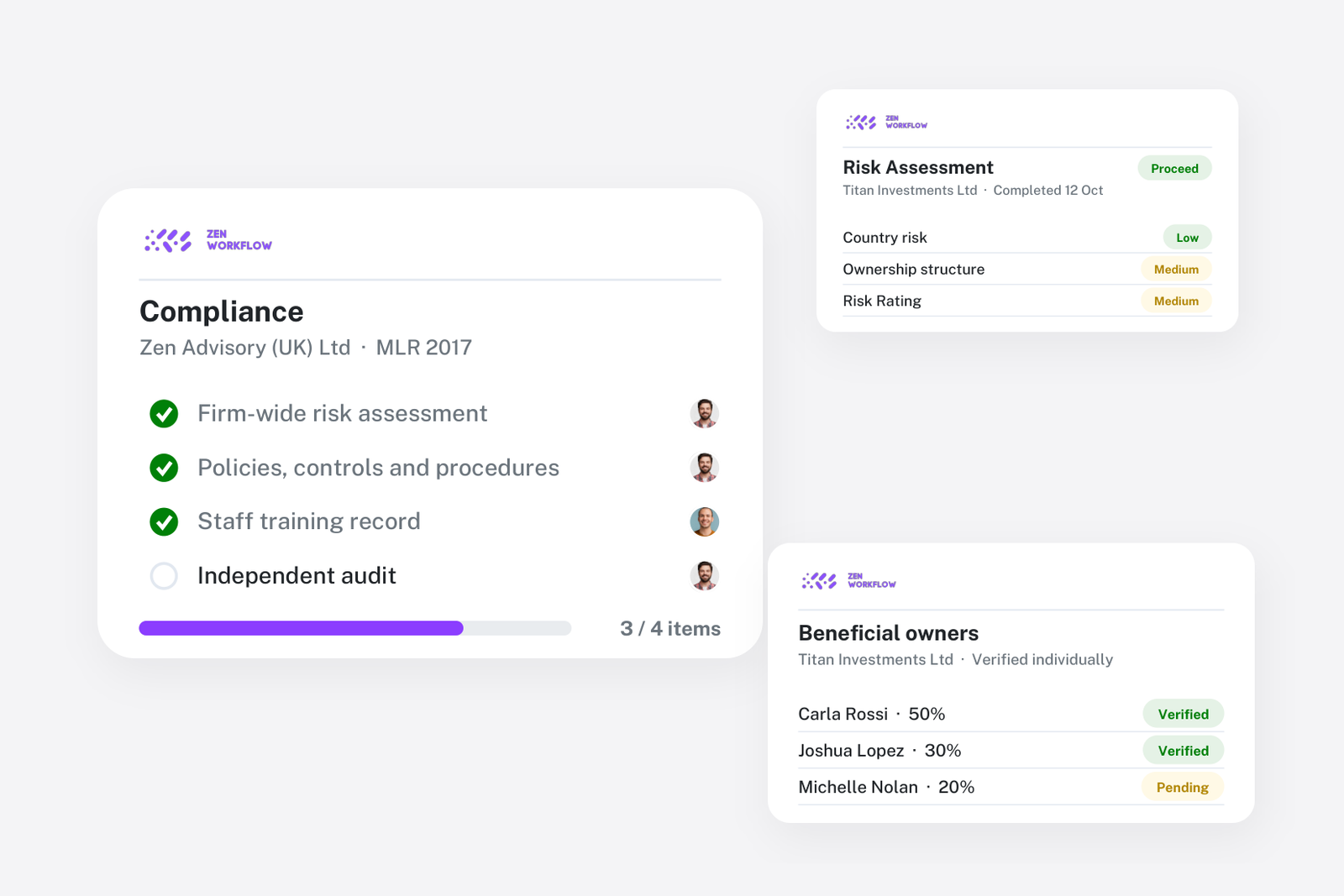
ZenWorkflow's AML and KYC module holds the firm's questionnaire and thresholds, verifies and screens beneficial owners as individuals, tracks document expiry, records ratings with reasoning and overrides, sets review dates from the rating and reports the firm's position across every client. Policies, the firm-wide assessment and training records live alongside the client files, so a supervisory visit is a report rather than a reconstruction. See how it fits accountancy firms and law firms, or book a demo.
Frequently asked
Does a sole practitioner need a firm-wide risk assessment? Yes. The regulation applies to every relevant person. The document is proportionate to the firm and can be short.
Is electronic identity verification enough on its own? It can satisfy verification of identity where the provider meets the standard, but the firm still has to identify beneficial owners, assess risk and understand the relationship.
How long must enhanced monitoring of a former PEP continue? At least twelve months after they cease to hold the position, longer where the firm's own assessment warrants it.
What is the difference between the client risk assessment and the firm-wide one? The firm-wide assessment describes the firm's own exposure and sets the policy. The client assessment applies that policy to one client. Supervisors expect both.