The Year-End Accounts Workflow: A Step-by-Step Process for Accounting Firms
A set of year-end accounts for an owner-managed company takes somewhere between eight and twenty-five hours of a firm's time, and anywhere between three weeks and nine months of elapsed time. The hours are the work. The months are the waiting: for records, for answers, for a review, for a signature. A firm that runs the same workflow for every client, with each wait visible and owned by someone, finishes in weeks. A firm that runs it from memory finishes in the last fortnight before the filing deadline, for every client at once.
This is the workflow. It is written for a small or mid-sized firm preparing statutory accounts and a corporation tax return for a private company, and it adapts to any jurisdiction's equivalents.
Key takeaways
- The year-end process has eleven steps, and three of them, records collection, client queries and client approval, account for most of the elapsed time.
- Every step has one owner and one output. A step with two owners has none.
- The workflow should be a template that is created for every client at their year end, with due dates set back from the filing deadline, not a checklist in someone's head.
- Time is recorded against the engagement throughout, so the fixed fee can be compared with the hours.
The workflow
1. Engagement check
Owner: manager. Output: confirmed scope and fee.
Confirm the engagement letter covers this year, the fee is agreed and the client's details are current. If the scope has changed, the fee is revisited now, not at invoicing. Engagement letters and scope creep covers why.
2. Records request
Owner: staff. Output: records request sent, due date set.
Send the client a specific list: bank statements to year end, sales and purchase records, loan statements, fixed asset additions and disposals, stock count, payroll reports, VAT returns, and the answers to last year's open points. A generic "please send your records" produces a generic response. Set a date, and chase on it.
This is the first and longest stall. The chase is what most firms do badly, because it is nobody's job. Make it the step owner's job, with a reminder.
3. Bookkeeping completion and review
Owner: staff. Output: trial balance to year end.
Bring the books to year end if the firm does the bookkeeping, or review the client's if they do. Check the bank is reconciled, the control accounts agree, the VAT reconciles to the returns and the payroll agrees to the reports.
4. Reconciliations and schedules
Owner: staff. Output: working papers for every balance sheet line.
Fixed assets and depreciation, debtors and creditors with ageing, accruals and prepayments, loans and interest, directors' loan accounts, stock, VAT and PAYE. Each schedule reconciles to the trial balance and is cross-referenced.
5. Client queries
Owner: staff. Output: query list answered.
Everything that could not be resolved from the records goes on one list, sent once, with a due date. Not five emails over three weeks. The second stall. Treat it like the records request: owned, dated, chased.
6. Adjustments and draft accounts
Owner: staff. Output: draft statutory accounts and adjusted trial balance.
Post the year-end adjustments, prepare the draft accounts in the required format and reconcile them to the adjusted trial balance. Note the points for the reviewer.
7. Manager review
Owner: manager. Output: review points cleared.
Analytical review against prior year, check of the schedules, the disclosures and the points raised. Review points go back to the preparer and are cleared before the file moves on. Record the time: review is the step most often under-recorded.
8. Partner review and sign-off
Owner: partner. Output: accounts approved for issue to the client.
The partner reviews the file, the key judgements and the final accounts. For a firm with a four-eyes policy this is where it is enforced.
9. Client meeting and approval
Owner: partner or manager. Output: signed accounts.
Present the accounts, explain the result and the tax, agree any final changes and obtain the signed approval. The third stall. A client meeting scheduled at step 2, for a date after the expected step 8, removes most of it.
10. Tax computation and return
Owner: staff, tax reviewer. Output: computation and return approved.
Prepare the corporation tax computation from the approved accounts, review it, agree it with the client and prepare the return. Many firms run this as a parallel workflow linked to the accounts one, so it has its own owner and dates.
11. Filing and close
Owner: staff. Output: accounts and return filed, confirmations on file, invoice raised.
File the accounts with the registrar and the return with the tax authority, save the submission confirmations, raise the invoice from the engagement, record the carry-forward points for next year and close the workflow. The invoice is part of this step, not a separate task for the end of the quarter. That is how work in progress stops accumulating.
The timeline in practice
| Step | Elapsed time, well run | Where it goes wrong |
|---|---|---|
| Records request to receipt | 2 to 4 weeks | Months, when nobody chases |
| Bookkeeping to draft | 1 to 2 weeks | Fine, usually |
| Queries | 1 week | Weeks, when sent piecemeal |
| Reviews | 1 week | Weeks, when the reviewer's queue is invisible |
| Client approval | 1 week | Months, without a scheduled meeting |
| Tax and filing | 1 week | Last-minute, when run separately |
The difference between the two columns is not skill. It is whether each wait is owned and visible.
Running it as a template
Turn the eleven steps into a workflow template with an owner role, a due date offset from the filing deadline and the standard outputs attached to each step. When a client's year end passes, the workflow is created from the template with the dates set, assigned, and visible on the firm's work list beside every other client's. The partner sees, in one view, which clients are waiting on records, which are in review and which are waiting on a signature. Fixed-fee engagements carry an hours budget so overruns show while the work is live. Standardising recurring engagements with templates describes the mechanics, and never missing a filing deadline covers the deadline side.
In ZenWorkflow
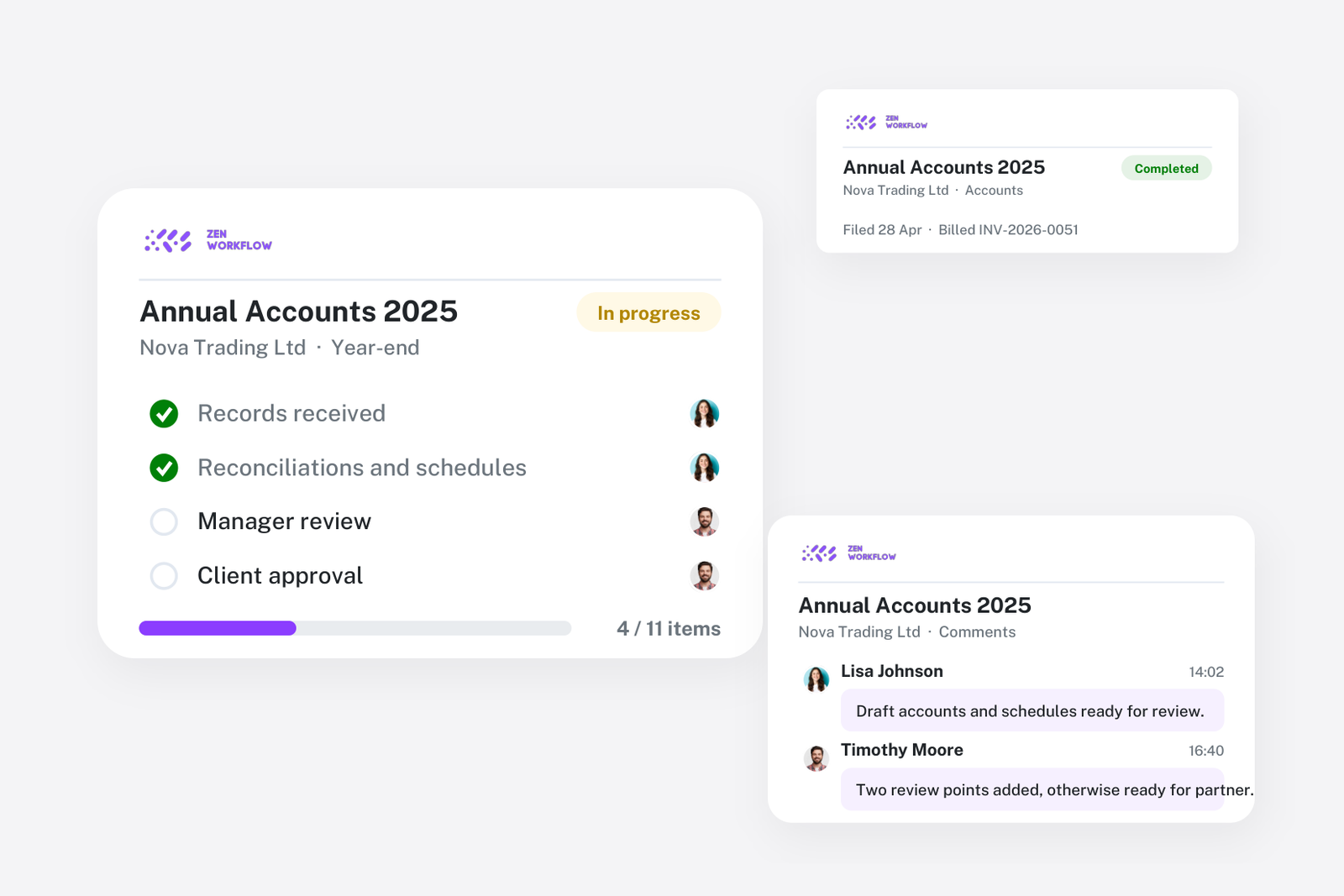
ZenWorkflow creates the year-end workflow for each client from the firm's template when the service falls due, with steps, owners, due dates set from the client's year end and the filing deadline, records requests and query lists against the client, and time recorded against the engagement. The invoice is raised from the workflow at step 11. The workflow management page describes templates and recurrence, and the public template gallery has year-end templates to start from. Accountants are the firm type it was built for first.
Frequently asked
Should tax be part of the same workflow or a separate one? Separate but linked, with its own owner and dates, so that a delay in one does not hide the other. Most firms run them in parallel from step 9.
How far ahead of the filing deadline should the workflow start? The records request should go out within two weeks of the year end. The whole process is then complete months before the deadline for most clients, which is what makes the deadline month survivable.
What if the client sends records late every year? Record it, price it and say so at engagement renewal. A late-records surcharge in the engagement letter changes behaviour faster than any reminder.