What Is Work in Progress (WIP) in a Professional Firm? Definition, Valuation and Ageing
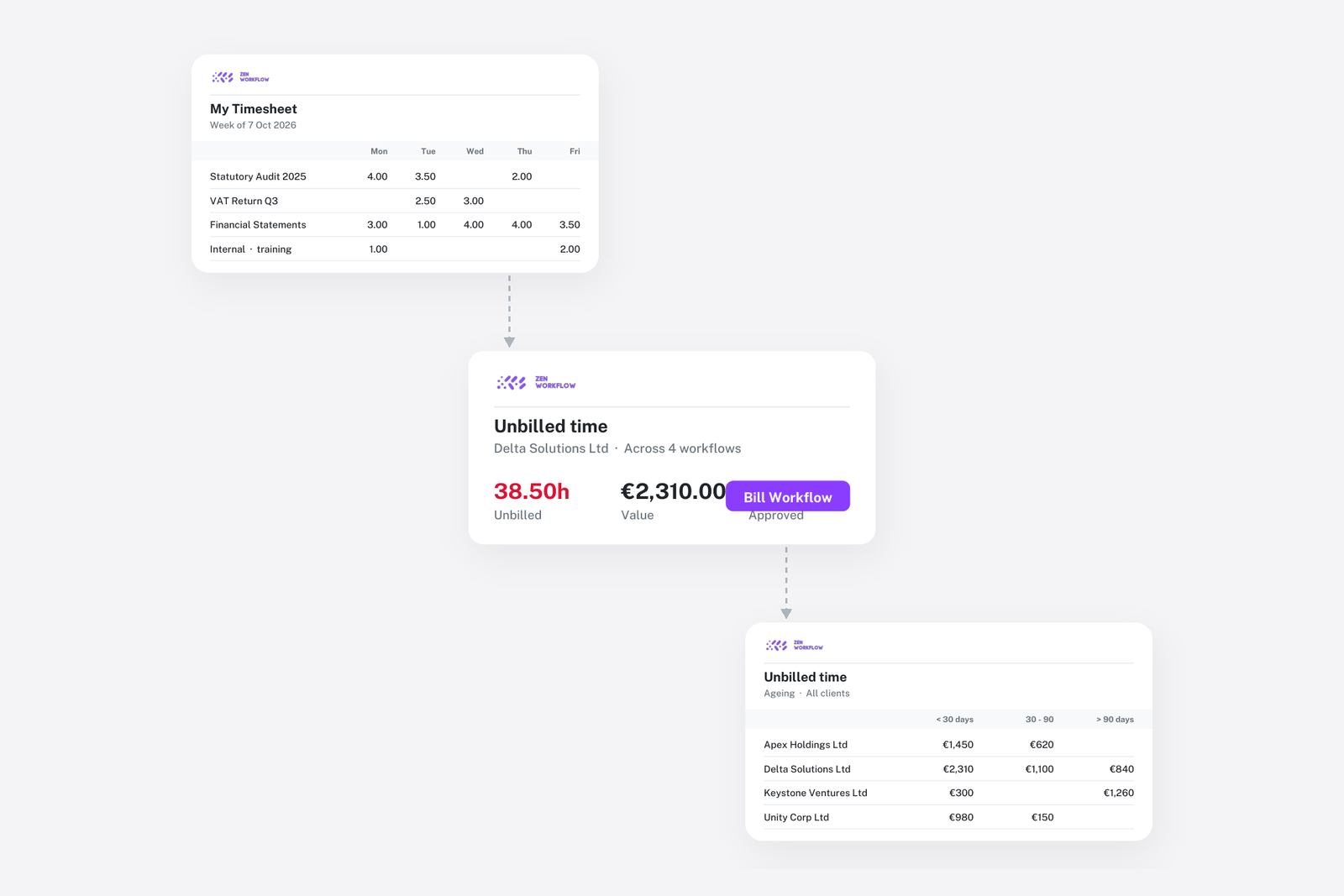
Work in progress, or WIP, is the value of time and expenses a firm has recorded against client work but has not yet invoiced. It is the firm's unbilled work. In an accounting, audit or law firm it is usually the largest asset nobody looks at, and the one most likely to quietly lose value: unbilled time that reaches ninety days old is rarely billed in full.
Key takeaways
- WIP = recorded time at standard rates + unbilled expenses, for work not yet invoiced.
- WIP days = WIP ÷ annual fee income × 365. Under 30 is good; over 60 means invoices are being raised late.
- WIP ageing groups the balance by how long it has been unbilled. The over-90-day bucket is money the firm has mostly already lost.
- WIP falls in only three ways: it is invoiced, it is written off, or it is forgotten. The third is the expensive one.
How is WIP valued?
The usual basis is the standard value of recorded time: hours multiplied by each person's charge-out rate, plus any expenses incurred on the client's behalf. Some firms value fixed-fee work at the proportion of the fee earned rather than at the time spent, which is more accurate for accounts purposes but hides underpriced fees. For management reporting, standard value is the better basis because the gap between it and what is eventually invoiced is the realisation rate, and the firm needs to see that gap.
WIP days
WIP days = (WIP balance ÷ annual fee income) × 365
A firm with 1,000,000 of annual fees and a WIP balance of 120,000 carries 44 days of unbilled work. That number is the first half of lock-up, the total time between doing work and being paid.
| WIP days | Reading |
|---|---|
| Under 30 | Billing on completion or monthly. Good. |
| 30 to 60 | Billing at period end. Common, and thirty days of cash left on the table. |
| Over 60 | Invoices are late and some of the balance will not be billed. |
Audit and litigation work run higher by nature of long engagements. Compare the firm against its own history, by partner and by service.
Why does WIP ageing matter?
WIP ageing lists the balance in buckets: under 30 days, 30 to 60, 60 to 90, over 90. The buckets predict what will happen to the money. Recent WIP will be invoiced. WIP over 90 days has usually been passed over at least one billing run, which means a partner looked at it and did not feel able to bill it. Most of it will be written off, and the longer it sits the larger the write-off.
A monthly review of the ageing table by partner changes behaviour faster than any other single report, because it makes the forgotten work visible with a name next to it.
How does WIP become a write-off?
Why firms write off billable time covers the mechanics. In summary: time is recorded, the invoice is raised from memory or from a fixed fee rather than from the ledger, the recorded time is not matched to it, and the surplus sits as WIP until someone clears it. The clearing is the write-off. Nobody decided it; it accumulated.
How to manage WIP
- Bill from the ledger. The person raising the invoice sees the unbilled time and expenses by client and engagement, not a blank form.
- Bill on completion. Invoice when the engagement ends or monthly for ongoing work, never only at quarter end.
- Separate written-off from unbilled. Time the firm has decided not to bill is marked as written off, with a reason and a name. What remains is genuinely pending.
- Review ageing monthly, by partner. The over-90 bucket is the agenda.
- Budget fixed-fee work. A fixed-fee engagement with an hours budget shows its overrun while the work is in progress, not when the WIP is cleared.
WIP in ZenWorkflow
ZenWorkflow holds recorded time and expenses against each client and workflow and shows the unbilled balance, with its age, on the client's billing page before an invoice is raised. Invoices are built from that balance, write-offs are recorded with the person and reason, and WIP ageing by client and partner is a report. The time tracking page covers how time gets in and billing how it gets out.
Frequently asked
Is WIP an asset in the firm's accounts? Yes, usually valued at the lower of cost and net realisable value under the applicable standard. Management reporting at standard rates is a different purpose and a different number.
Should WIP include fixed-fee work? For management purposes, yes, at standard value, so that underpriced fees become visible. For the statutory accounts, follow the firm's accounting policy.
What is a reasonable WIP write-off rate? Under five percent of recorded time is good. Over ten percent means either the fees or the billing discipline need attention.