What Is Realisation Rate? Definition, Formula and Benchmarks for Professional Firms
Realisation rate is the percentage of the standard value of recorded time that a firm actually invoices. A firm that records time worth 100,000 at its standard rates and invoices 85,000 for that work has a realisation rate of 85 percent. The remaining 15 percent was written off, discounted or never billed.
Key takeaways
- Realisation rate = fees invoiced ÷ standard value of time recorded × 100.
- It measures how much of the work done turns into revenue. Utilisation measures how much of the available time was worked. They are different numbers and should be read together.
- Most professional firms sit between 80 and 90 percent. Above 90 is strong. Below 80 means roughly a fifth of the work is unpaid.
- The rate falls for three reasons: time written off at invoice, time left unbilled, and underpriced fixed fees.
The formula
Realisation rate = (fees invoiced for the period ÷ standard value of time recorded for the period) × 100
Standard value means the hours recorded multiplied by each person's standard charge-out rate. The period should be long enough to smooth billing cycles. A quarter is the usual minimum, and a rolling twelve months is more reliable.
The rate should be calculated at three levels: for the firm, per service and per client. The firm figure hides the problem. The per-service figure shows which fees are wrong. The per-client figure shows which relationships are uneconomic.
A worked example
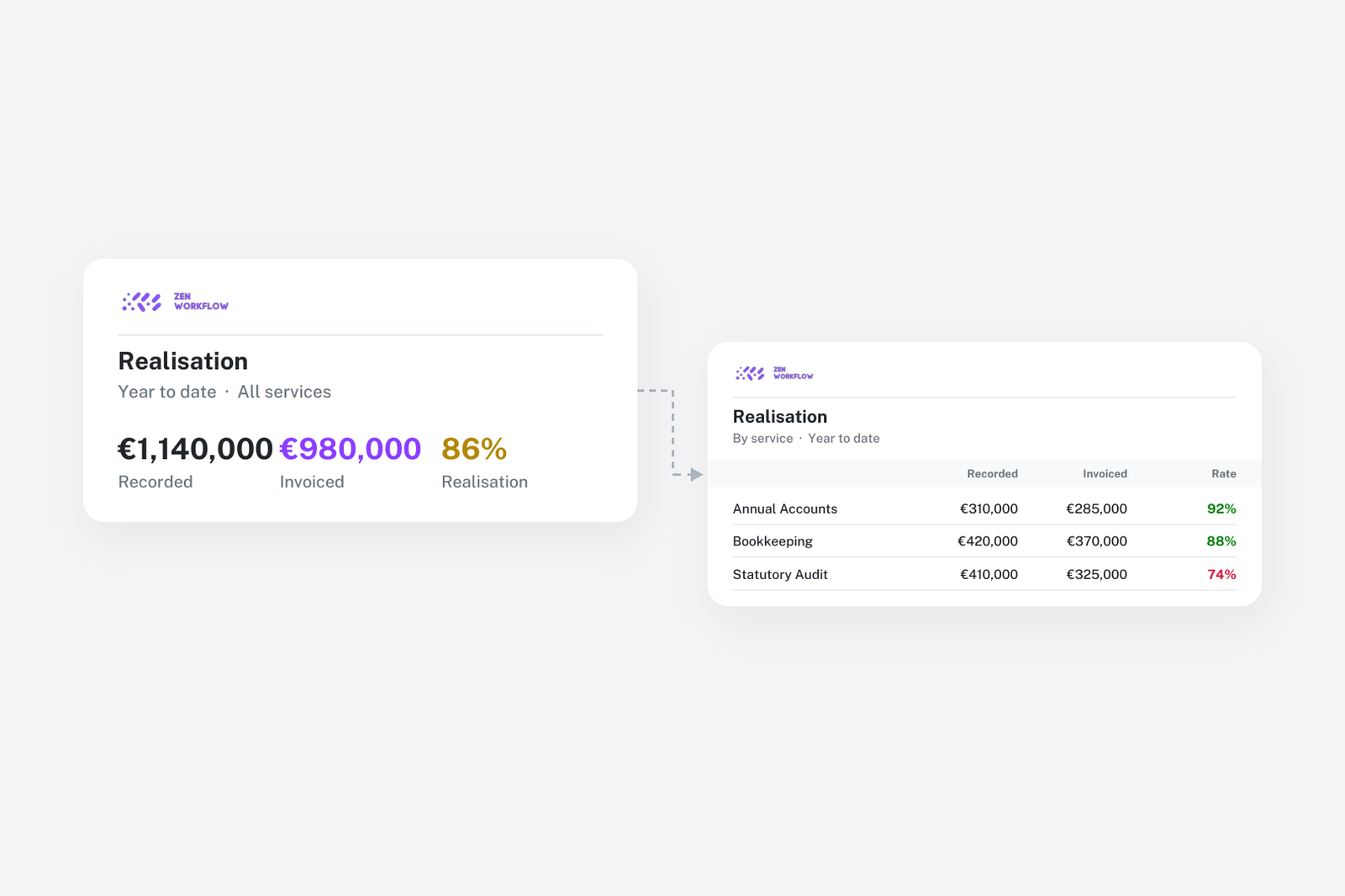
A ten-person firm records 12,000 chargeable hours in a year at an average standard rate of 95, a standard value of 1,140,000. It invoices 980,000 for that work.
Realisation rate = 980,000 ÷ 1,140,000 × 100 = 86 percent.
Broken down by service: annual accounts at 92 percent, bookkeeping at 88 percent, and audit at 74 percent. The audit fees have not been repriced in four years, and the firm is absorbing the difference. That is the finding the firm-wide number alone would never produce.
What is a good realisation rate?
| Rate | Reading |
|---|---|
| Over 92% | Excellent. Fees match the work and billing is disciplined. |
| 88 to 92% | Good. Typical of well-run firms. |
| 80 to 88% | Average. Worth investigating by service. |
| Under 80% | A fifth or more of the work is unpaid. Pricing or billing discipline, usually both. |
Benchmarks vary by sector. Audit and legal work tend to run lower because of scope uncertainty. Bookkeeping and payroll on fixed fees run higher if the fees are right.
Why does realisation rate fall?
Write-offs at invoice. A partner reviews the recorded time, decides the client will not pay for it and reduces the bill. Individually reasonable, collectively a pricing problem being paid for by the firm.
Unbilled time. Time recorded and never invoiced, because the invoice was raised from memory rather than from the ledger, or because the time aged past the point where billing felt comfortable. Unbilled time older than ninety days is rarely recovered.
Underpriced fixed fees. A fixed fee that assumed thirty hours and consumed forty has a built-in realisation of 75 percent. The fee, not the work, is the problem.
Why firms write off billable time covers the three leaks in detail, and pricing engagements covers fixing the fees.
How to improve realisation rate
- Calculate it by service and by client, not only for the firm.
- Reprice the services that run consistently below budget.
- Raise invoices from the recorded time, with the unbilled balance visible, rather than from a blank form.
- Record write-offs explicitly, with a reason, so they can be reviewed.
- Review work in progress ageing monthly and bill or write off anything over ninety days.
Realisation rate versus utilisation rate
Utilisation is chargeable hours as a percentage of available hours. It says how busy people are. Realisation says how much of that busy time was paid for. A firm can have 85 percent utilisation and 70 percent realisation, which means it is busy doing work it does not get paid for. The two numbers belong on the same page, and both belong among the eight numbers a partner should review monthly.
Measuring it in ZenWorkflow
ZenWorkflow records time against clients and services and raises invoices from that time, so realisation by firm, service and client is a report rather than a spreadsheet. Unbilled time is visible with its age before an invoice is raised, and write-offs are recorded with the person and reason. The time tracking and billing pages describe the two halves.
Frequently asked
Is realisation rate the same as recovery rate? The terms are often used interchangeably. Some firms use recovery rate for the share of invoiced fees actually collected, which is a separate measure.
Should fixed-fee work be included? Yes. Record the time on fixed-fee work and compare the fee to its standard value. Without that, the firm cannot tell which fixed fees lose money.
What period should it cover? At least a quarter, and ideally a rolling twelve months, so that billing cycles do not distort it.