The Eight Numbers a Firm Partner Should Review Every Month
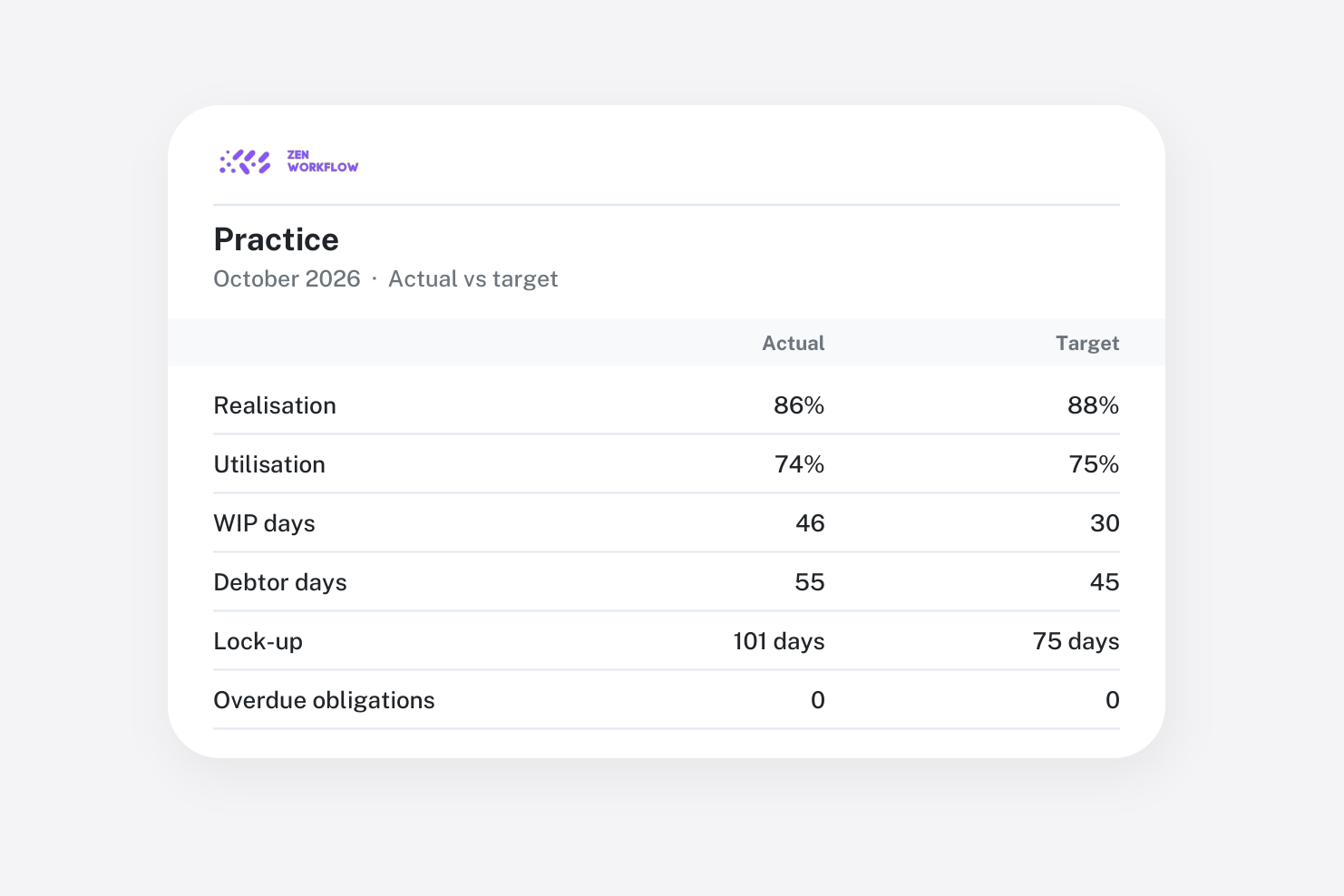
Most firms review the profit and loss monthly and nothing else, which is like driving by looking at the fuel gauge. The profit and loss says what happened. The numbers below say why, and they say it while something can still be done.
They are chosen because together they cover the four ways a firm loses money: not charging for the work, not doing enough work, not collecting what was charged, and depending on too few clients. The ninth, overdue obligations, is included because the regulator does not care about the other eight.
1. Realisation rate
Fees invoiced as a percentage of the standard value of time recorded. The single most important number in a professional firm and the one most firms cannot produce. Target above 88 percent. Review by service and by partner, because the firm average hides the problem. Measuring the leak covers how to find the gap.
2. Utilisation
Chargeable hours as a percentage of available hours, per person. Target 70 to 80 percent for staff, lower for managers and partners who carry supervision and business development. Below 60 for a fee-earner is a workload or a recording problem. Above 90 for a sustained period is a burnout problem and a capacity signal: the firm needs to hire or stop taking work.
Review utilisation and realisation together. High utilisation with low realisation means the firm is busy doing work it does not get paid for.
3. Work in progress days
Unbilled time, valued at standard rates, divided by average daily fee income. It says how many days of work are sitting unbilled. Target under 30. Over 60 means invoices are being raised late and a portion of the balance will never be billed. The companion table is WIP ageing: how much of the balance is over 90 days old.
4. Debtor days
Receivables divided by average daily fee income. How long clients take to pay. Target under 45; under 30 is good. A rising trend is an early warning of a client in difficulty or a firm that has stopped chasing. Review the aged debtors list alongside it and name the five largest.
5. Lock-up
WIP days plus debtor days. The total time between doing the work and receiving the cash. Target under 75. This is the number that explains why a profitable firm has no money: at 120 days of lock-up, a third of the year's fees are owed to the firm at any moment. Reducing lock-up by 30 days on a million of fees releases roughly 80,000.
6. Write-offs
Time explicitly written off in the month, as a value and as a percentage of time recorded, by partner and by reason. This is distinct from realisation: it isolates the deliberate decisions from the neglect. A firm that records write-offs with reasons learns within a quarter which services are underpriced and which clients are uneconomic.
7. Client concentration
Fee income from the largest client and the largest five, as a percentage of the total. Above 15 percent for one client or 40 percent for five is a dependency the firm should know about and price for. The number rarely changes month to month, which is why it is forgotten until the client leaves.
8. Overdue obligations
The count of filings, reviews and deadlines past due, and the count due in the next 30 days. Statutory filings, AML periodic reviews, document expiries, licence renewals. Target zero overdue. This is the only number on the list the regulator will ask about, and the only one where a bad month can cost the firm its licence rather than its margin.
The monthly review
One page, eight numbers, this month against last month and the same month last year, with a target column. Fifteen minutes in the partners' meeting. The discipline is in producing the page on the same day every month and in asking, for each number that moved the wrong way, what the firm will do before the next page.
| Number | Target | Watch when |
|---|---|---|
| Realisation | over 88% | below 85% |
| Utilisation, staff | 70 to 80% | below 60% or above 90% |
| WIP days | under 30 | over 60 |
| Debtor days | under 45 | over 60 |
| Lock-up | under 75 | over 100 |
| Write-offs | under 5% of time | over 10% |
| Largest client | under 15% | over 20% |
| Overdue obligations | 0 | any |
The targets are indicative. Audit firms run higher WIP days by nature of the work; corporate-services firms with many small entities run lower concentration. Set the firm's own targets from its own history and move them each year.
Why firms do not produce the page
Because the eight numbers need time, fees, invoices, receipts, clients and deadlines in one place, and in most firms they are in five. Realisation needs time and invoices. Lock-up needs invoices and receipts. Concentration needs fees by client. Obligations need the client's services and the calendar. Assembling it by hand takes a day a month, so it is done once, admired, and not repeated.
Doing it in ZenWorkflow
ZenWorkflow holds all six sources on the client record, and the reports produce realisation, utilisation, unbilled time with ageing, debtors, write-offs and fees by client without assembly. Overdue filings and AML reviews are on the compliance views with the person responsible. The use case on seeing the health of the practice walks through the reports, and the case study shows what a firm did with them.
Frequently asked
Should staff see these numbers? Utilisation and realisation, yes, for their own work. The firm-level page is for partners, and the system's permissions should enforce that.
Monthly or weekly? Monthly for the page. Weekly for timesheet completeness, which is what makes the monthly numbers true.
What if we do not record time on fixed fees? Then realisation, utilisation and write-offs cannot be calculated, and the firm cannot tell which fixed fees are losing money. Record the time anyway. It is the measurement, not the bill.