Why Firms Write Off Billable Time, and How to Measure How Much
Ask a partner what the firm's realisation rate is and the answer is usually a guess. Ask what was written off last quarter and the answer is a smaller guess. The time was recorded, the work was done, the client was invoiced and somewhere between those three events a slice of the fee disappeared. Because it disappeared in small pieces across many clients, nobody saw it go.
This article is about finding it.
The three places time leaks
Before it is recorded. Time that was worked and never entered. The call taken in the car, the twenty minutes answering an email, the extra day on a job that was already over budget and nobody wanted to make it look worse. This is the largest leak in most firms and the only one that leaves no evidence. The sole remedy is making time entry fast enough to do in the moment, and reviewing timesheets weekly rather than at month end.
Between recording and billing. Time that was entered and then sat. Work in progress that aged past the point where the partner felt comfortable billing it, or was forgotten when the invoice was raised from memory rather than from the ledger. Unbilled time that is older than ninety days is rarely billed at all.
At the invoice. Time that was reviewed and deliberately reduced. The partner looked at the hours, decided the client would not pay for them and cut the bill. Sometimes this is right. Often it is a pricing or scoping problem being paid for by the firm instead of fixed.
The metrics
Four numbers make the leak visible. They need time, fees and invoices in one place to calculate, which is why many firms have never seen them.
Realisation rate. Fees invoiced divided by the standard value of time recorded, for a period. A firm recording time worth 100,000 and invoicing 82,000 has a realisation rate of 82 percent. Below 85 is a problem, below 75 is a crisis. Calculate it per client and per service, because the firm average hides the three clients that are dragging it down.
Write-off rate. The portion of recorded time that was explicitly written off, as opposed to still sitting unbilled. This separates deliberate cuts from neglect. A high write-off rate with a low unbilled balance is a pricing problem. A low write-off rate with a high unbilled balance is a billing discipline problem.
WIP ageing. Unbilled time grouped by how long it has been unbilled: under 30 days, 30 to 60, 60 to 90, over 90. The over-90 bucket is money the firm has probably already lost. A monthly review of this one table changes behaviour faster than anything else.
Budget variance. For fixed-fee work, the hours spent against the hours the fee assumed. A fixed fee with no hours budget cannot be measured. A fixed fee that is consistently over budget is underpriced, and the write-off is simply the variance arriving at the invoice.
Why it keeps happening
Firms write off time for reasons that sound reasonable one at a time.
The client relationship is valued. The work took longer because of the firm's own inefficiency. The junior was learning. The scope was unclear and the client would dispute the extra. The partner does not want the conversation.
Each is a decision to absorb a cost. The problem is that the decisions are made invoice by invoice, by different partners, with no view of the total. A firm that would never approve a 15 percent fee cut across the board approves it every month, one invoice at a time.
What to change
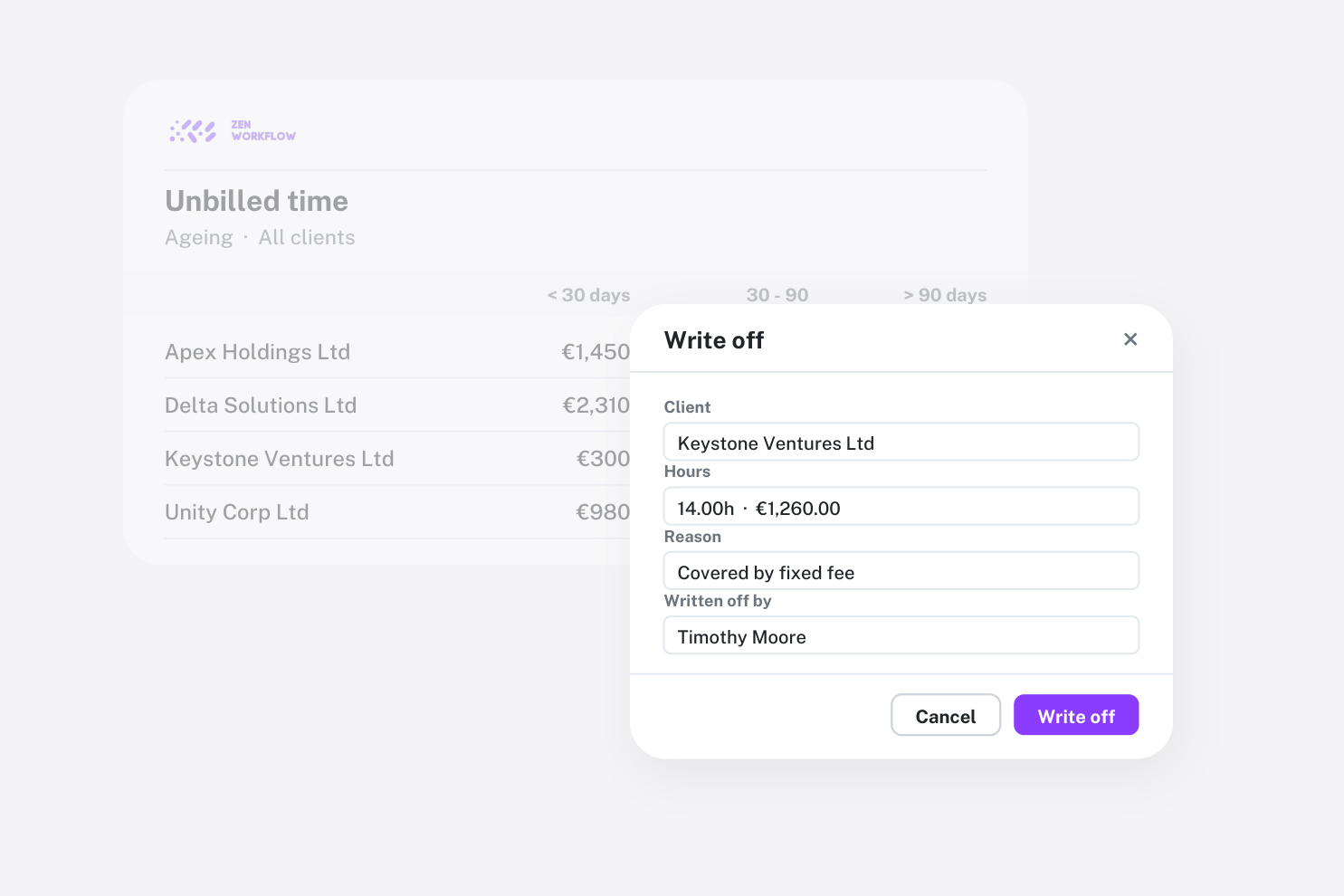
Make the unbilled balance visible before the invoice. The partner raising an invoice should be looking at the recorded time, the fee agreed and the variance, not at a blank invoice form. The decision to reduce should be a visible act with a reason, not a number typed lower than another number.
Review WIP ageing monthly, by partner. Not to assign blame, but because the over-90 bucket does not clear itself.
Separate write-off from unbilled. Time that is written off should be marked as written off, by someone, on a date. Time that is merely sitting should look different. When the two are mixed, neither gets managed.
Fix pricing where the variance is systematic. If the same service is over budget for most clients, the fee is wrong, not the staff. See fixed fees or hourly billing.
Scope in writing. Most disputed time is time on work the client did not know they were asking for. An engagement letter with a process for out-of-scope work turns a write-off into a conversation. See engagement letters and scope creep.
A worked example
A twelve-person firm records 14,000 hours a year at an average standard rate of 90, which is 1,260,000 of recorded value. It invoices 1,040,000. Realisation is 82.5 percent, and 220,000 has gone. On investigation: 60,000 was explicitly written off at invoice, mostly on two underpriced audit clients; 90,000 is sitting unbilled, of which 55,000 is over 90 days old; and the remaining 70,000 is the estimate of time never recorded, derived from comparing staff hours worked to hours entered.
The firm repriced the two audits, billed the 35,000 of unbilled time under 90 days, wrote off the rest with reasons, and moved to weekly timesheet review. Realisation the following year was 89 percent, worth roughly 80,000 at the same volume of work. Nothing about the work changed.
Doing it in ZenWorkflow
ZenWorkflow holds time, services, fees and invoices on the same client, so realisation, write-off rate, WIP ageing and budget variance come out of the reports rather than a spreadsheet exercise. Unbilled time appears on the client's billing page with its age before an invoice is raised, write-offs are recorded with the person and date, and fixed-fee workflows carry an hours budget so variance is visible while the work is in progress. The use case on recovering unbilled time and fees shows the process, and the time tracking page describes the timesheet.
Frequently asked
What realisation rate should a firm aim for? Above 90 percent is achievable with disciplined scoping and billing. Most firms sit between 80 and 88 without trying.
Is writing off time always bad? No. A deliberate, recorded write-off on a valued client is a commercial decision. An undecided write-off that happened because nobody looked is a leak.
How do we measure time that was never recorded? Compare contracted or expected hours per person with hours entered. The gap is an estimate, not a fact, but a consistent gap of 10 percent or more is a signal.