Engagement Letters: Scope, Scope Creep and Getting Paid for Extra Work
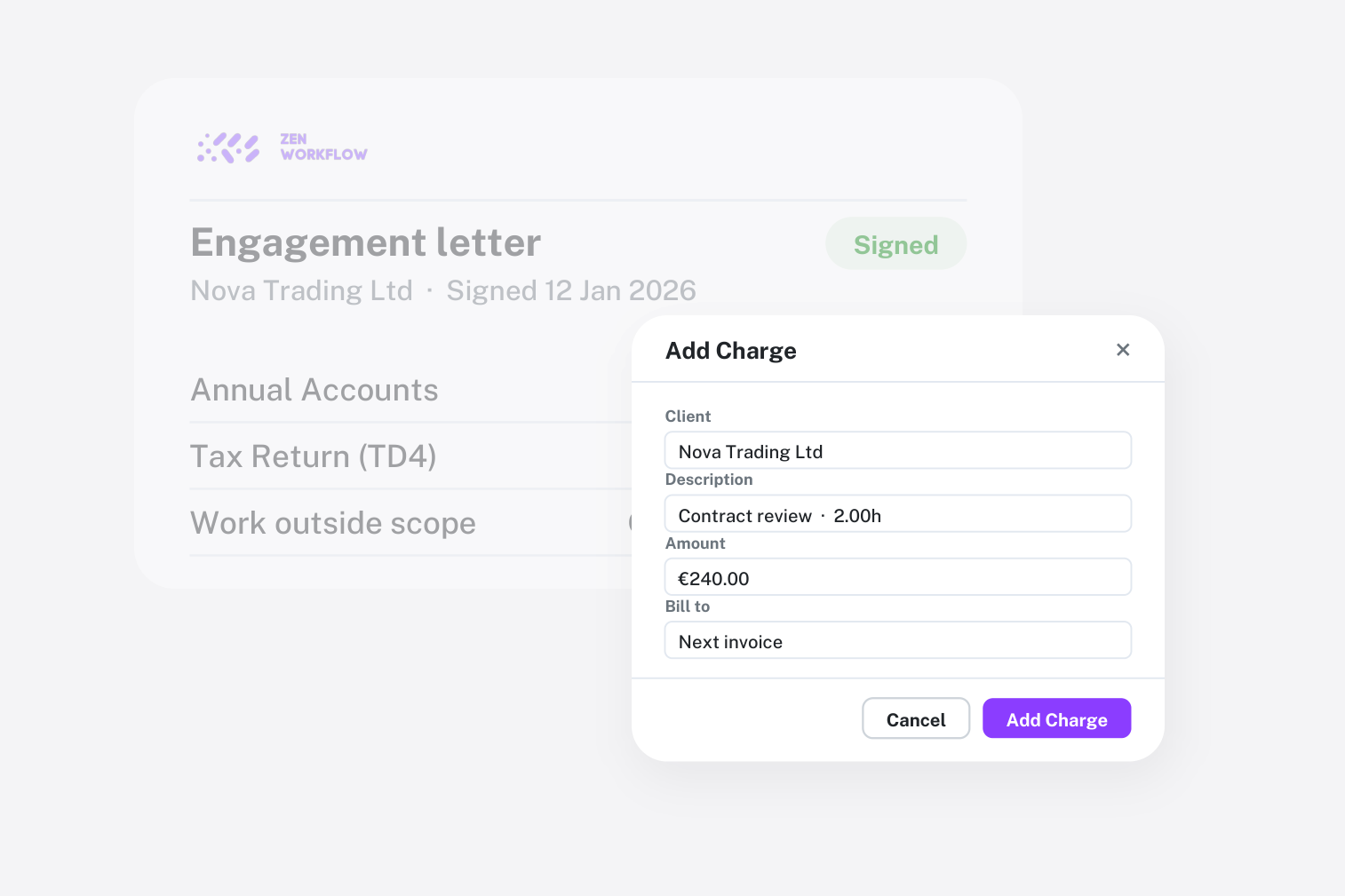
A client emails on a Tuesday asking for "a quick look" at a contract. The manager spends two hours on it. Nobody quotes it, nobody records it against anything billable and, when the quarter's invoice is raised, the two hours are either absorbed into the fixed fee or written off because the client will not expect them. Multiply by every client and every Tuesday.
Scope creep is not a client behaviour. It is the absence of a firm process for the moment a request falls outside the letter. This article covers the letter, the moment and the process.
What the letter has to define
The engagement letter is the firm's contract, its scope and its defence. It should be per service, from a template, and signed before work begins. Six things in it do most of the work.
The services, specifically. Not "accounting services" but "preparation of annual financial statements for the year ending 31 December, corporation tax computation and return, and the annual return filing". The specificity is what makes "something else" recognisable.
What is excluded. The things the client might assume are included: advice on transactions, dealing with tax authority enquiries, management accounts, due diligence on acquisitions. A short list of exclusions prevents a long list of disputes.
The fee and its basis. The amount, whether it is fixed, hourly, retainer or per unit, when it is invoiced and the payment terms. If fixed, what it assumes: number of transactions, quality of records, number of entities. See pricing engagements.
The process for additional work. This is the clause that is usually missing. Work outside the services listed will be quoted separately before it starts, or charged at the rates stated, and the firm will say which before doing it.
Responsibilities. What the client has to provide and by when, and what happens to the deadline and the fee if they do not. Late records are the most common cause of fixed-fee overruns, and a letter that is silent on them leaves the firm paying for the client's delay.
Term and renewal. When the engagement ends or renews, and that the fee is reviewed at renewal. An annual renewal is the natural moment to raise a fee, and a letter without one makes every increase an ambush.
Recognising the moment
Out-of-scope requests do not announce themselves. They arrive as "while you're at it", "quick question", "can you just", and "the bank needs". The person receiving the request is usually a manager or a junior who wants to be helpful and does not have the letter in front of them.
Two habits make the moment visible. First, every request is logged against the client, so the person can see what the client's services are before answering. Second, the question "is this in the letter?" is asked out loud, by anyone, without it being a reproach. A firm where juniors feel they cannot raise it will absorb the work.
The process
When a request is outside scope, there are three acceptable responses and one unacceptable one.
Quote it. "Happy to help. That is outside the annual engagement, so I will send you a fee for it today." A short written quote, accepted by email, and the work starts. For most requests this takes ten minutes and the client expects it.
Charge it at the stated rate. For small requests where a quote is disproportionate, the letter's hourly rate applies and the client was told so in the letter. The work is recorded against the client as ad-hoc time and invoiced with the next bill, labelled as what it was.
Absorb it deliberately. Sometimes the right commercial decision is to do the work for free: a small favour for a valuable client, a goodwill gesture after a firm error. The decision is made by a partner, recorded as a write-off with a reason, and visible in the firm's numbers. It is a choice, not a leak.
Absorb it by accident. The unacceptable one. The work is done, recorded nowhere or recorded against the fixed-fee job, and disappears into the realisation rate. See why firms write off billable time.
Ad-hoc work needs a home
The practical obstacle to charging for extra work is that it has nowhere to go. The firm's system has a workflow for the annual accounts and nothing for the two hours on the contract, so the two hours get recorded against the accounts and vanish. The fix is a standing place for ad-hoc work per client: a charge or a short workflow that carries the time, the agreed fee and the description that will appear on the invoice. When the invoice is raised, the extra work is a line the client recognises, because they agreed it.
Renewal as the control point
Scope creep accumulates. A client that was straightforward three years ago now has two subsidiaries, a payroll and a quarterly VAT problem, all handled under the original fee. The annual renewal is where the firm compares the services actually delivered against the letter and reprices. A firm with time recorded by service can see exactly what has crept. A firm without it is negotiating from memory against a client who remembers the original fee precisely.
Doing it in ZenWorkflow
ZenWorkflow holds each client's engaged services with their fee basis, so anyone answering a request can see what is in scope. Out-of-scope work is recorded as an ad-hoc charge or workflow on the client with its own fee and description, and appears on the next invoice as its own line beside the fixed fees and recurring time. Deliberate write-offs are recorded with a reason and show in the reports. Engagement letters are generated from the firm's own templates with the client's details filled in, and stored against the client. The client management page describes the record, and the use case on coordinating approvals covers how quotes and invoices are signed off.
Frequently asked
Do we need a separate letter for every service? One letter can list several services. What matters is that each service is specific and the exclusions and additional-work process are present.
What if the client disputes a charge for extra work? The letter's additional-work clause and the written quote are the answer. Without them the firm usually concedes.
How small is too small to charge? The firm decides a threshold, below which work is absorbed and recorded as such. The threshold should be a policy, not a feeling.