The EU AML Package and AMLA: What Changes for Accountants, Lawyers and Corporate Service Providers
The EU anti-money-laundering package is the largest change to the rules for professional firms since the fourth directive in 2015. Three instruments were adopted in 2024: a regulation that applies directly to obliged entities across the Union, a sixth directive for the parts that stay national, and a regulation creating the Anti-Money Laundering Authority, AMLA, in Frankfurt. The regulation applies from 10 July 2027. Firms that treat that as a distant date will be rebuilding their procedures in the spring of 2027.
This guide is a practical summary for accounting, audit, legal and corporate-services firms. It is not legal advice, and the texts and the guidance AMLA issues take precedence.
Key takeaways
- One rulebook. Regulation (EU) 2024/1624 sets customer due diligence, beneficial ownership and internal-control rules directly, without national transposition. National supervisors stay, national variations shrink.
- AMLA coordinates. The authority supervises a small number of high-risk financial institutions directly and oversees national supervisors for everyone else, including the professional sector, through common standards and peer review.
- Beneficial ownership tightens. The 25 percent threshold stays, with explicit rules for multi-layer structures and control, and more information to be collected and filed.
- Deadline: 10 July 2027. Most of the regulation applies then. The directive's national provisions, including supervision and registers, are transposed by the same date.
What is in the package?
The AML Regulation, (EU) 2024/1624. The "single rulebook". It defines who is an obliged entity, what their internal policies and controls must contain, the customer due diligence and enhanced due diligence rules, beneficial ownership identification, record keeping and reporting. Because it is a regulation it applies as written in every member state.
The sixth AML Directive, (EU) 2024/1640. Covers what remains national: the organisation of supervisors and financial intelligence units, the beneficial ownership and bank account registers and access to them, and cooperation between authorities.
The AMLA Regulation, (EU) 2024/1620. Creates the authority, which began operating in 2025. It will directly supervise a selected group of cross-border financial institutions from 2028 and will coordinate and review the national supervisors of all other obliged entities, including those of accountants, lawyers and company service providers.
Who is an obliged entity under the regulation?
The list is familiar: auditors, external accountants and tax advisers; notaries and lawyers when they participate in financial or real-estate transactions or act for clients in company formation and management; trust and company service providers; real-estate agents; and others. The regulation adds some new categories and removes the ability of member states to carve out their own exemptions, so a firm that relied on a national exemption should check whether it survives.
What changes in customer due diligence?
The substance of due diligence is familiar from the fourth and fifth directives. What changes is that the detail is now set at EU level rather than in each supervisor's directive, and some of that detail is tighter.
- Identification data is specified: for natural persons, full name, date and place of birth, nationality, residential address and identity document number; for legal entities, name, legal form, registration number, registered address and the names of legal representatives.
- Verification sources are specified, including electronic identification under the eIDAS framework.
- Enhanced due diligence triggers are harmonised, covering high-risk third countries, politically exposed persons, and a set of risk factors the firm must consider.
- Simplified due diligence is only available where the firm's own risk assessment and the EU-level risk factors support it.
- Periodic review must happen on a risk basis and at least within intervals the regulation and AMLA's technical standards will set.
For a firm whose procedures already follow its national supervisor's directive the change is incremental. For a firm that has been applying a thin version of those directives it is not.
What changes for beneficial ownership?
The threshold stays at 25 percent, defined as ownership of 25 percent or more of the shares, voting rights or ownership interest, directly or indirectly. The regulation sets out how to calculate indirect ownership through layers, and separately defines control by other means, including the right to appoint or remove the majority of the board, veto rights and formal or informal agreements. Where no beneficial owner can be identified after all reasonable means are exhausted, the senior managing officials are recorded, and the firm must document what it tried.
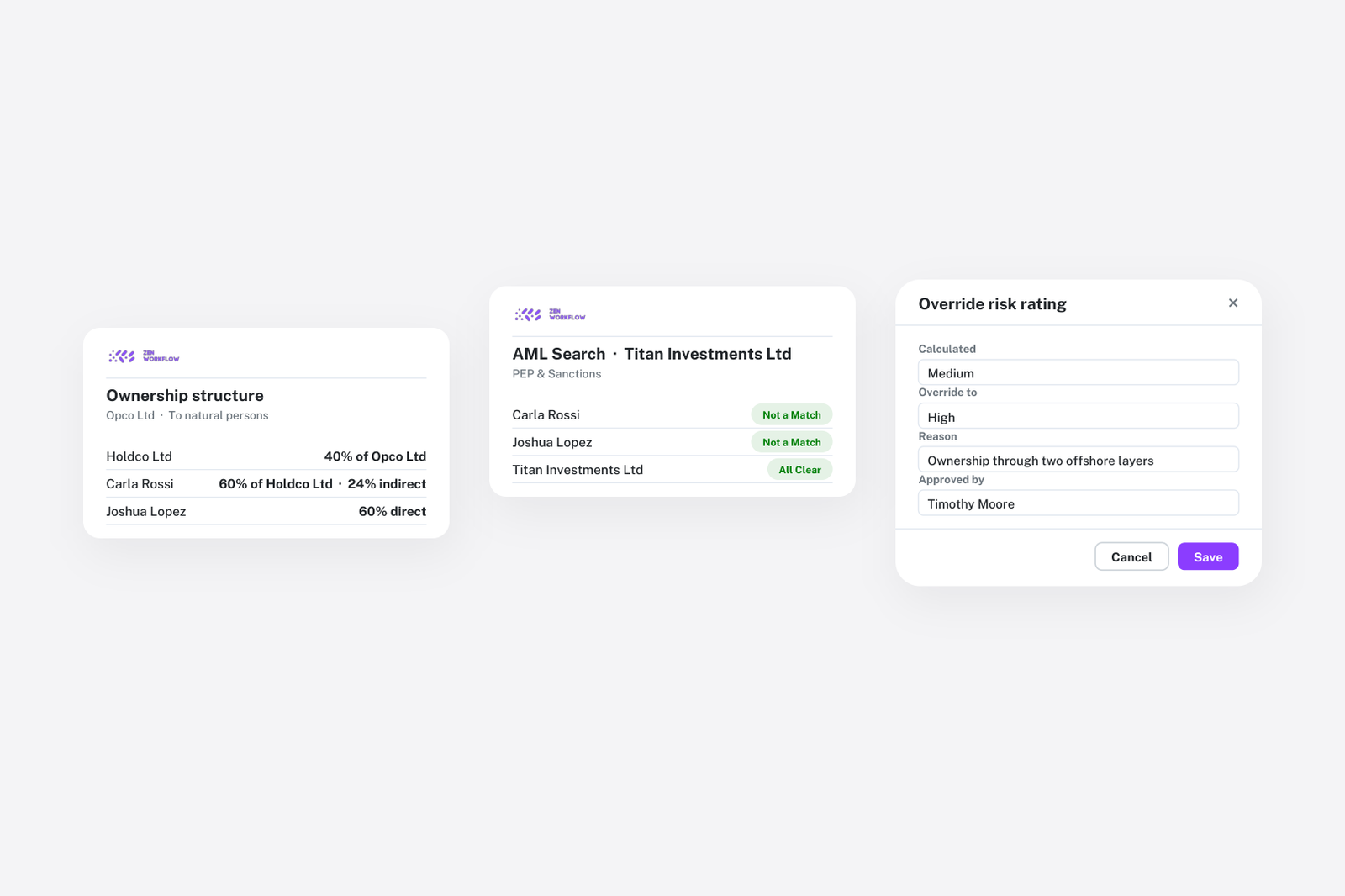
Trusts and similar arrangements have their own rules, and the information to be collected about each beneficial owner is longer than most firms currently hold. The practical effect for corporate-services providers administering layered structures is that the ownership chart on each file has to be complete to the natural persons, with percentages at each layer.
What are the internal-control requirements?
Every obliged entity must have a firm-wide risk assessment, written policies and procedures approved by management, a compliance manager at management level and a compliance officer responsible for day-to-day operation, employee training and screening, and, proportionate to size, an independent audit function. Groups must apply group-wide policies. Outsourcing of due diligence tasks is allowed within limits, with the firm remaining responsible.
Smaller firms will recognise most of this from existing rules. The requirement for a named management-level compliance manager in addition to a compliance officer is new for some.
What does AMLA do for professional firms?
AMLA does not inspect accounting or law firms directly. It issues regulatory technical standards and guidelines that national supervisors must apply, reviews those supervisors for effectiveness, and can step in where a national supervisor fails. The practical consequence is that supervision of the professional sector converges upward: inspection standards in the more lightly supervised member states move towards those in the strictest. Firms that have been inspected rarely should expect that to change.
What should a firm do before July 2027?
- Map current procedures to the regulation. Take the firm's existing AML manual and the regulation's articles on internal policies, due diligence and beneficial ownership, and note every gap. Most firms find the gaps in beneficial ownership detail, periodic review intervals and the data recorded at identification.
- Complete the ownership charts. Every corporate client should have a chart to the natural persons, with percentages at each layer and the basis for any control-by-other-means finding.
- Fix the identification data. Check that every client and beneficial owner record holds the full set of identification data the regulation lists.
- Set review intervals in policy and make sure the firm can see which clients are due.
- Name the compliance manager and compliance officer and record management approval of the policies.
- Train staff on the changes, and keep the record.
Doing it in ZenWorkflow
ZenWorkflow's AML and KYC module records beneficial owners as individuals with their identification data, percentages and the basis of control, screens each of them, holds the firm's own questionnaire and review intervals, and shows which clients are due or missing data across the whole client base. That is the information the regulation asks a firm to be able to produce, and the compliance report is where an inspector under the new regime will start. It serves corporate service providers, law firms, accountants and auditors. The guides to Cyprus and UK obligations cover the current national rules.
Frequently asked
When does the EU AML Regulation apply? From 10 July 2027 for most obliged entities. The directive's national provisions are transposed by the same date.
Does AMLA supervise accounting or law firms? Not directly. It sets standards for and reviews the national supervisors of the professional sector, and can intervene where they fail.
Does the beneficial ownership threshold change? No. It remains 25 percent, but the rules for indirect ownership through layers and for control by other means are set out explicitly, and more information must be collected.
Will national supervisors' directives still apply? National supervisors continue to supervise and issue guidance, but the substantive rules come from the regulation and AMLA's standards rather than from national transposition.
Does this affect UK firms? The UK is outside the regime. UK firms with EU operations or EU clients will meet it through those operations, and the UK rules are covered in the UK guide.