AML Obligations for Accounting, Audit and Corporate Services Firms in Cyprus
Cyprus professional firms live under one anti-money-laundering law and three supervisors. Accountants and auditors answer to ICPAC, lawyers to the Cyprus Bar Association, and administrative service providers to CySEC. Each supervisor issues its own directive, runs its own inspections and imposes its own sanctions, but the obligations trace back to the same statute: the Prevention and Suppression of Money Laundering and Terrorist Financing Law of 2007, Law 188(I)/2007, as amended to transpose the EU directives.
This guide sets out what the law and the directives require of a firm, in the order an inspector tends to ask about them. It is a practical summary, not legal advice, and your supervisor's current directive is the authority.
Key takeaways
- One law, three supervisors. Law 188(I)/2007 applies to all; ICPAC supervises accountants and auditors, the Cyprus Bar Association lawyers, and CySEC administrative service providers, each with its own directive.
- Named compliance officer, approved by the supervisor, who owns the policies, the internal reports, the reporting to MOKAS and an annual report to the partners.
- Firm-wide risk assessment first, then client due diligence with the beneficial owners verified and screened individually, then periodic review at an interval set by the rating.
- Inspections find the same three gaps: overdue reviews, beneficial owners identified but not verified, and ratings with no recorded reasoning.
Who is an obliged entity
The law applies to auditors, external accountants and tax advisors, to lawyers and law firms when they handle client funds or act in financial or real-estate transactions or company formation, and to administrative service providers licensed under Law 196(I)/2012. A firm that offers more than one of these services is supervised for each by the relevant body. A corporate services arm run from an accounting firm is a common example, and a frequent source of confusion about which directive applies to which file.
The compliance officer
Every obliged entity appoints a compliance officer, approved by its supervisor, who owns the firm's AML framework. The role carries specific duties: drafting and maintaining the firm's policies and procedures, deciding on internal suspicious-activity reports, reporting to MOKAS, the Cyprus financial intelligence unit, and producing an annual report to the firm's board or partners on the operation of the framework. Inspectors read that annual report first. A thin one tells them what to expect from the rest of the file.
The firm-wide risk assessment
Before assessing any client, the firm documents its own exposure: the types of client it serves, the jurisdictions they come from, the services it provides, how it is introduced to clients and how it delivers to them. The assessment produces the firm's policy on which clients get standard, simplified or enhanced due diligence and on how often each category is reviewed. It is reviewed at least annually and whenever the firm's business changes. A firm that cannot produce it has no basis for the client ratings that follow.
Customer due diligence
Due diligence happens before the business relationship begins and again on a schedule the risk rating sets. The core steps are the same across all three supervisors:
- Identify and verify the client from reliable, independent documents. For a company that means the certificate of incorporation, the register of directors and shareholders, the memorandum and articles and the registered office.
- Identify the beneficial owners. Every natural person who ultimately owns or controls more than 25 percent, directly or indirectly, or who exercises control by other means, and the senior managing official where no such person can be found. Verify their identity as you would a client's.
- Understand the purpose and nature of the relationship, and for higher-risk clients the source of funds and source of wealth.
- Screen the client and each beneficial owner against sanctions lists, for politically exposed person status and for adverse media.
- Rate the risk and record the reasoning. What a client risk assessment must contain covers the document in detail.
Enhanced due diligence is mandatory for politically exposed persons and their family and close associates, for clients connected to high-risk third countries on the EU list, and in any other case the firm's own assessment rates as high risk. It means more information, senior approval and closer ongoing monitoring.
The beneficial ownership register
Cyprus companies file their beneficial owners with the Registrar of Companies, and obliged entities consult the register as part of due diligence. The register is not a substitute for the firm's own verification. Where the firm's findings differ from the register, it is expected to note the discrepancy and, under the current rules, to report it.
Ongoing monitoring and periodic review
The obligation does not end at onboarding. The firm monitors the relationship for activity inconsistent with what it knows about the client, keeps documents current and repeats the risk assessment at the interval its rating sets. Most Cyprus firms work on annual review for high risk, two years for medium and three for low, with any trigger event bringing the review forward. The periodic review is where most inspection findings arise, because it depends on someone noticing the date. Running the review cycle is covered separately.
Reporting to MOKAS
When a member of staff knows or suspects that funds are the proceeds of crime, they report internally to the compliance officer, who decides whether to report to MOKAS. The internal report, the decision and the reasoning are recorded whether or not an external report follows. Tipping off the client is an offence. Staff need to know the internal route, and training records need to show they were told.
Record keeping
Due diligence records, transaction records and the risk assessment are kept for five years after the end of the business relationship or the transaction, in a form that lets the firm reconstruct what it knew and when. The practical test is whether a file from three years ago can be produced in a day with its documents, its screening results and its rating intact.
Training
Staff receive AML training on joining and periodically thereafter, covering the law, the firm's procedures and how to recognise and report suspicion. The firm keeps a record of who was trained, when and on what. Inspectors ask for it.
What inspections look at
Supervisory visits in Cyprus follow a recognisable pattern. The inspector asks for the firm-wide risk assessment, the compliance officer's annual report, the training record and a sample of client files. In the files they look for the beneficial owner chain, the verification documents and their dates, the screening evidence, the risk rating with its reasoning, and whether the periodic review happened when the rating said it should. Findings cluster in three places: reviews that are overdue, beneficial owners identified but not verified, and ratings with no recorded basis.
Doing it in ZenWorkflow
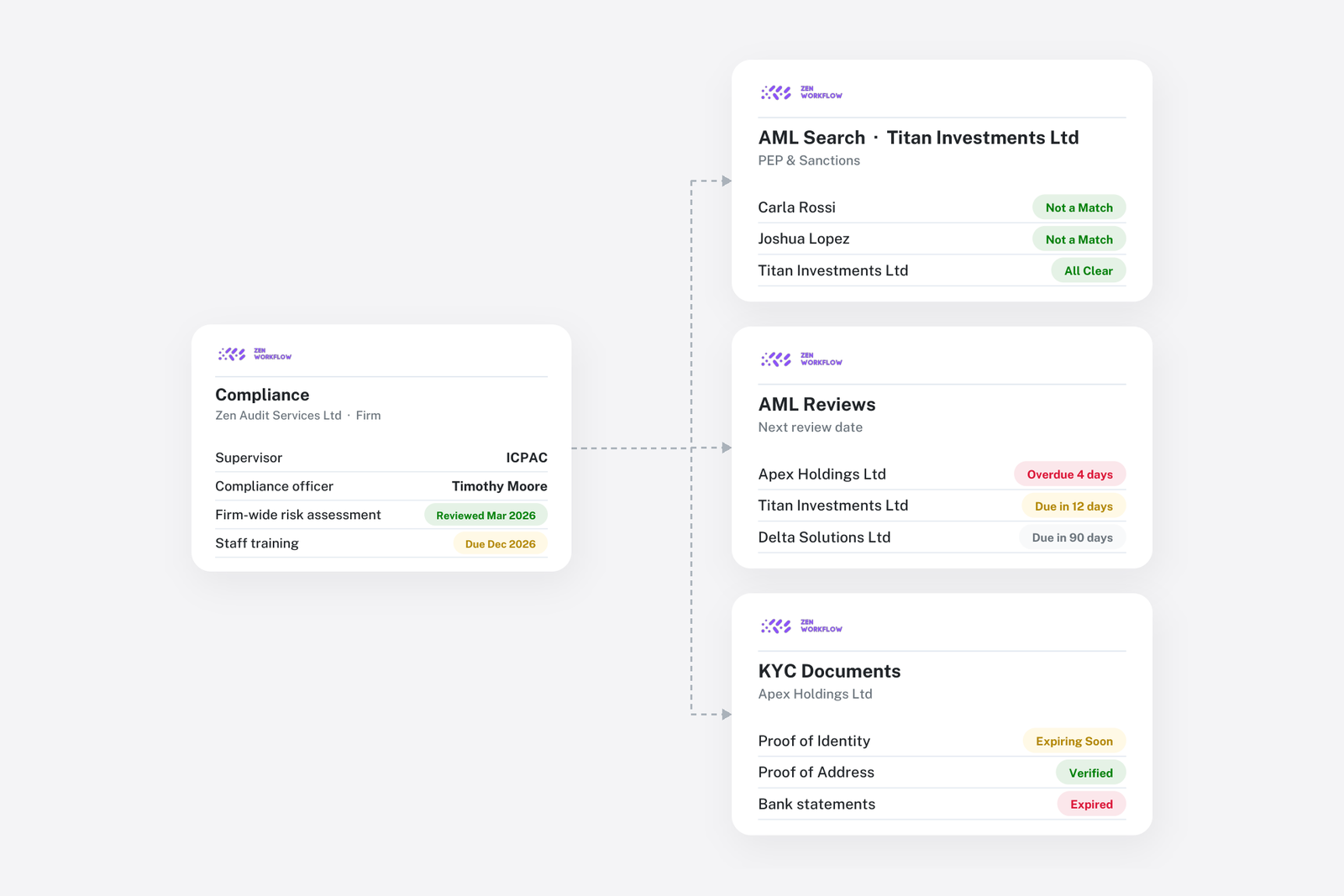
ZenWorkflow was built inside a Cyprus audit firm, which is why the AML and KYC module mirrors this list: the firm's own questionnaire and thresholds, beneficial owners recorded and screened as individuals, documents with expiry dates, ratings with reasoning and overrides, review dates set from the rating, and a compliance report that shows the firm's position across every client. It serves accountants, auditors, law firms and corporate service providers from one client record. Book a demo to see it against your supervisor's directive.
Frequently asked
Our firm is both an audit firm and an ASP. Which directive applies? Both, to the respective work. Most firms run one framework that meets the stricter of the two requirements and document which supervisor covers which service line.
Do we need to verify beneficial owners if they are on the register? Yes. The register is a source to consult, not verification in itself.
How often must the firm-wide risk assessment be updated? At least annually, and whenever the firm's services, client base or the national risk assessment change.
Can a small firm outsource the compliance officer role? The supervisors allow an external compliance officer in some circumstances, subject to approval. Responsibility stays with the firm.