What a Client AML Risk Assessment Must Contain
Every firm subject to anti-money-laundering rules has to assess the risk of each client and apply due diligence in proportion to it. Most firms do this. Fewer can show how they did it. When an inspector opens a file and finds a form with "Medium" circled and a signature, the question that follows is "why medium?", and the file has to answer it.
This article describes what a defensible client risk assessment contains. It is written for accounting, audit, legal and corporate-services firms in the EU and UK, whose rules share a common structure even where the detail differs. It is not legal advice, and your supervisor's guidance takes precedence over anything here.
The purpose of the document
The risk assessment does three jobs. It decides how much due diligence the client gets. It decides how often the client is reviewed. And it is the record that proves the firm thought about the client's risk before acting. A document that does the first two without the third is the one that fails inspection.
The risk factors
The rules group risk into a handful of categories, and the assessment should score each one explicitly.
Customer risk. Who the client is. A locally owned trading company is different from a trust, a nominee structure or a cash-intensive business. Ownership complexity, whether any owner is a politically exposed person, and whether the client was referred or walked in all belong here.
Geographic risk. Where the client, its owners and its activities are. Jurisdictions on the EU high-risk list, countries subject to sanctions and countries known for weak controls score higher. Note the jurisdiction of every owner, not only the company.
Product and service risk. What the firm is doing for the client. Forming companies, acting as nominee director or providing a registered office carries more risk than preparing a tax return. Handling client money is its own category.
Delivery channel risk. How the relationship is conducted. A client met in person with original documents is lower risk than one onboarded remotely through an intermediary.
Transaction and behaviour risk. Once the relationship exists, whether the activity matches what the client said it would be. Unusual payments, unexplained changes of ownership and requests that make no commercial sense all raise the rating.
How the rating is derived
The method matters less than its consistency. Two approaches work.
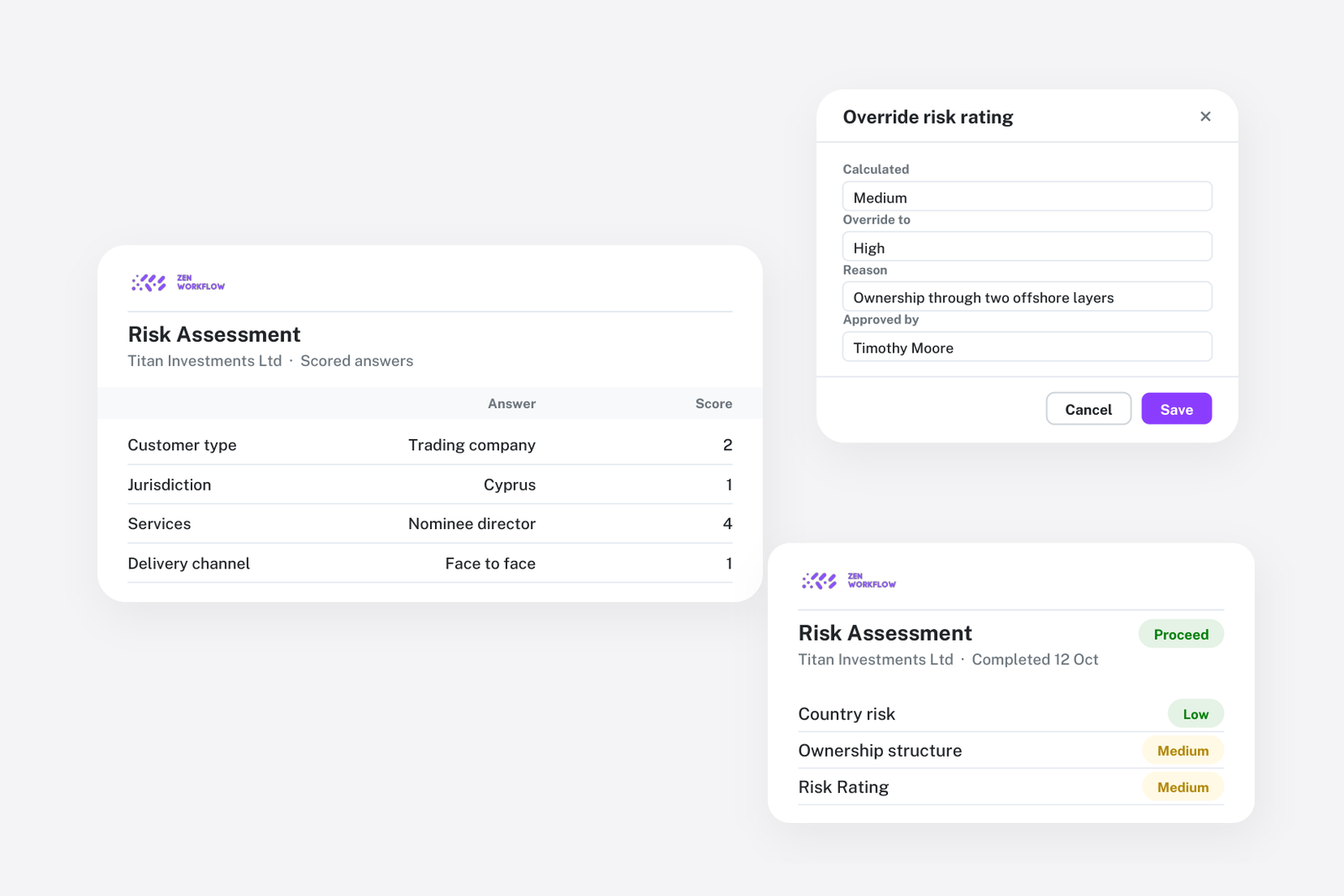
Weighted scoring. Each factor has a weight and each answer a score. The total maps to a rating by thresholds the firm sets. This is auditable and easy to apply uniformly, and it is what most firms of any size end up with. The weights and thresholds are the firm's policy and should be written down and approved.
Highest factor wins. Any single high-risk factor makes the client high risk regardless of the others. Simpler, and harsher. Many firms combine the two: a score for the overall rating plus a list of factors that automatically force high risk, such as a politically exposed owner or a sanctioned jurisdiction.
Whichever is used, the assessment should show the answer to each factor and the rating that resulted. A total score without the answers behind it is only slightly better than a circled word.
Overrides
A partner can decide the computed rating is wrong on the facts. That is legitimate, and sometimes required. What the file needs is the original rating, the final rating, who changed it, when and why. An override without a reason is the single most common finding in file reviews.
What the rating triggers
Due diligence level. Standard due diligence for most clients. Simplified where the rules permit and the firm's policy allows. Enhanced due diligence for high-risk clients and in every case where the rules require it, which generally includes politically exposed persons and high-risk third countries. Enhanced due diligence means more: source of wealth, senior management approval, closer monitoring.
Review interval. Each rating carries a period after which the assessment is repeated. A common scheme is annual for high risk, two years for medium and three for low, with any trigger event bringing the review forward. The interval is policy; what matters is that it is applied and that the next review date is recorded on the file.
Approval. High-risk clients typically need sign-off above the person who did the assessment. The approval, with name and date, is part of the record.
The record
The rules require the firm to keep due diligence records for a period after the relationship ends, five years under the EU directives. The assessment should be kept with the evidence it relied on: the identity documents, the screening results and the ownership information at the time. A snapshot of what the firm knew when it decided matters, because the client's details will change and the file must show what was known then.
A checklist for the document
- The client's identity and the people behind it
- Each risk factor and the answer given
- The score or rule that produced the rating
- The rating, and any override with its reason and author
- The due diligence level applied
- Approval by the appropriate person
- The date of the assessment and the next review date
- The evidence relied on, kept with the assessment
Where firms go wrong
The assessments are fine and the reviews are missed. The file is complete on day one and nobody opens it again until the inspector does. The second failure is screening the company and not the people, so a new director arrives unchecked. The third is a form that produces a rating without recording the answers, usually because it was designed for speed rather than evidence.
All three are organisational rather than legal problems, and they are solved by keeping the assessment on the client record where review dates, people and documents are visible together.
Doing it in ZenWorkflow
ZenWorkflow's AML and KYC module lets the firm define the questionnaire, the weights and the thresholds as its own policy, scores each client's rating from the answers, records overrides with their reason and sets the next review date from the rating. The people behind the entity are screened individually and their documents carry expiry dates. The use case on periodic AML reviews describes how firms run the review cycle once the assessments exist.
Frequently asked
Can the assessment be a single page? Yes, if the single page shows the factors, the answers, the rating and the approval. Length is not the test; traceability is.
Must we score every factor numerically? No. The firm chooses the method. It must apply it consistently and be able to explain it.
How often should the methodology itself be reviewed? At least annually, and whenever the rules, the supervisor's guidance or the firm's services change.