Fixed Fees or Hourly: Pricing Engagements Without Losing Money
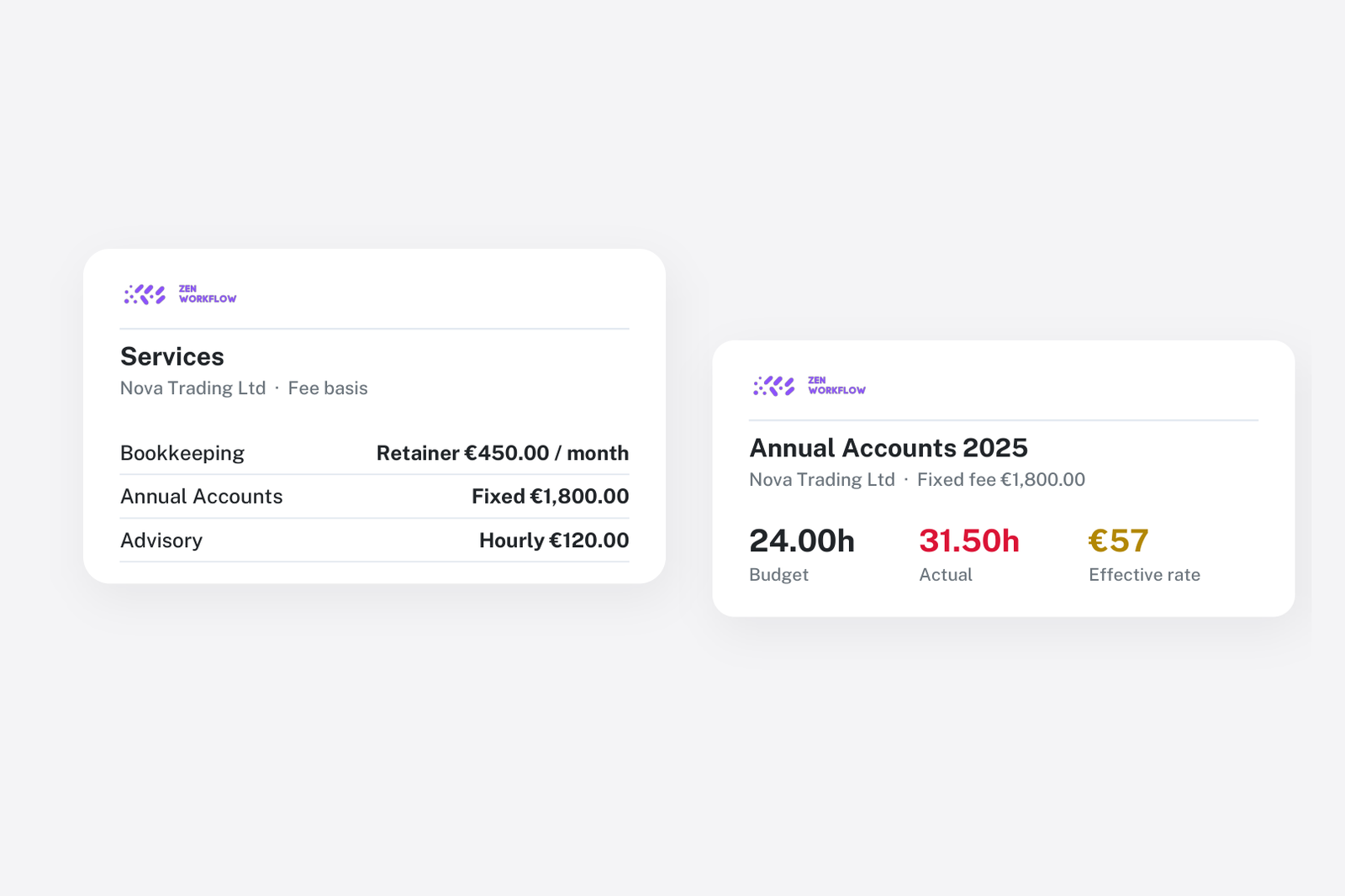
The pricing debate in professional firms is usually framed as a choice: hourly or fixed. In practice almost every firm uses both, and the mistake is not which model they chose but that they chose it per client, under negotiation, with no record of what the fee assumed. Three years later the firm has two hundred clients on two hundred fee arrangements and no way to tell which ones make money.
This article is about pricing per service, not per client, and about building every fee from the same ingredient: time.
The four fee bases
Hourly. Time recorded at a rate per person. Simple to administer, fair to the firm, disliked by clients because the total is unknown until the invoice arrives. Right for genuinely open-ended work: disputes, investigations, advisory with no defined end.
Fixed fee. An agreed amount for a defined scope. Clients prefer it, cash flow is predictable, and the firm carries the risk of the work taking longer. Right for repeatable, well-understood work: annual accounts, a standard audit, a company formation, a tax return.
Retainer. A fixed monthly amount for an agreed range of ongoing services. A fixed fee spread over time. Right for bookkeeping, payroll, ongoing compliance and anything the client needs every month.
Per unit. A price per transaction, per employee, per filing. Scales with the client's volume without renegotiation. Right for payroll, bookkeeping with volatile volume and corporate-services work priced per entity.
The question for each service the firm offers is which basis fits the nature of the work. The answer should be the same for every client receiving that service, with a stated process for exceptions.
Building a fixed fee
A fixed fee that was not built from a time budget is a guess, and the firm will not learn whether the guess was right until the time is already spent.
- List the steps in the engagement from the workflow template. For an annual accounts job: records collection, bookkeeping review, adjustments, draft, review, client meeting, finalisation, filing.
- Estimate hours per step by grade of staff. Use the last three years of recorded time on similar clients if the firm has it. If it has not, this is the first reason to start recording time properly.
- Cost the hours at each grade's cost rate, which is salary plus overhead divided by chargeable hours.
- Add the margin the firm wants on that service.
- Adjust for the client's complexity with a small number of defined multipliers: number of entities, transaction volume, quality of records. Three bands are enough. Twenty are a negotiation.
- Record the hours budget with the fee. This is the step most firms skip, and it is the one that makes the fee measurable.
Knowing when a fee is wrong
A fee is wrong when the hours budget is consistently exceeded across clients, not when one client overruns once. Three signals:
Budget variance by service. For each fixed-fee service, the actual hours against the budget, averaged across all clients on that service. A service running at 120 percent of budget is underpriced by roughly a sixth, and the firm is paying the difference in write-offs.
Effective rate. Fee invoiced divided by hours spent, per engagement. Compare it with the firm's target hourly rate. A fixed fee that yields an effective rate of 55 when the target is 90 is a fixed fee that should be renegotiated or the work re-scoped.
Client-level margin. Fees for all services to a client, less the cost of the hours. Some clients are worth less than nothing, and the firm usually knows which ones without looking. Looking confirms it with a number and makes the conversation possible.
Raising a fee
The reason fees stay wrong is that raising them requires a conversation. Three things make it easier.
Tie the increase to the renewal of the engagement letter, so it is expected. State the reason, which is usually scope: the client has grown, the volume is higher, the records are worse. Offer a choice where possible: the same fee with reduced scope, or the higher fee for what they are now getting.
A firm that raises fees annually by a small amount has an easier time than one that waits five years and asks for 40 percent.
Scope is what makes a fixed fee safe
A fixed fee covers a defined scope. Without the definition, every request is inside the fee and the fee is unlimited. The engagement letter should say what is included, what is excluded, and what happens when the client asks for something else: a quote before the work, or an hourly rate stated in advance. See engagement letters and scope creep.
Mixed engagements
Most real clients have a retainer for ongoing work, a fixed fee for the annual engagement and an hourly rate for whatever comes up. The firm's system has to be able to invoice all three on one document and keep them distinguishable, so that the retainer's hours are not quietly absorbing the advisory time. If the invoice cannot show a fixed line, a time line and a disbursement together, the firm will be doing this in a spreadsheet.
Doing it in ZenWorkflow
ZenWorkflow holds each service with its fee basis on the client, carries an hours budget on fixed-fee workflows so variance is visible as the work progresses, and raises invoices that combine fixed fees, time at a rate and expenses on one document. Realisation, effective rate and budget variance by service come from the reports. The use case on measuring profitability by client and service shows the numbers, and the billing and invoicing page describes the invoice.
Frequently asked
Should we move everything to fixed fees? Move the repeatable services. Keep hourly for open-ended work. The mistake is a fixed fee on work whose scope cannot be defined.
How often should fees be reviewed? Annually, at engagement letter renewal, using the budget variance of the previous year.
What if the client refuses an increase? Then the firm decides whether the client is worth keeping at the current margin, and that is a decision it can only make with the margin in front of it.