What Is Utilisation Rate? Definition, Formula and Targets for Professional Firms
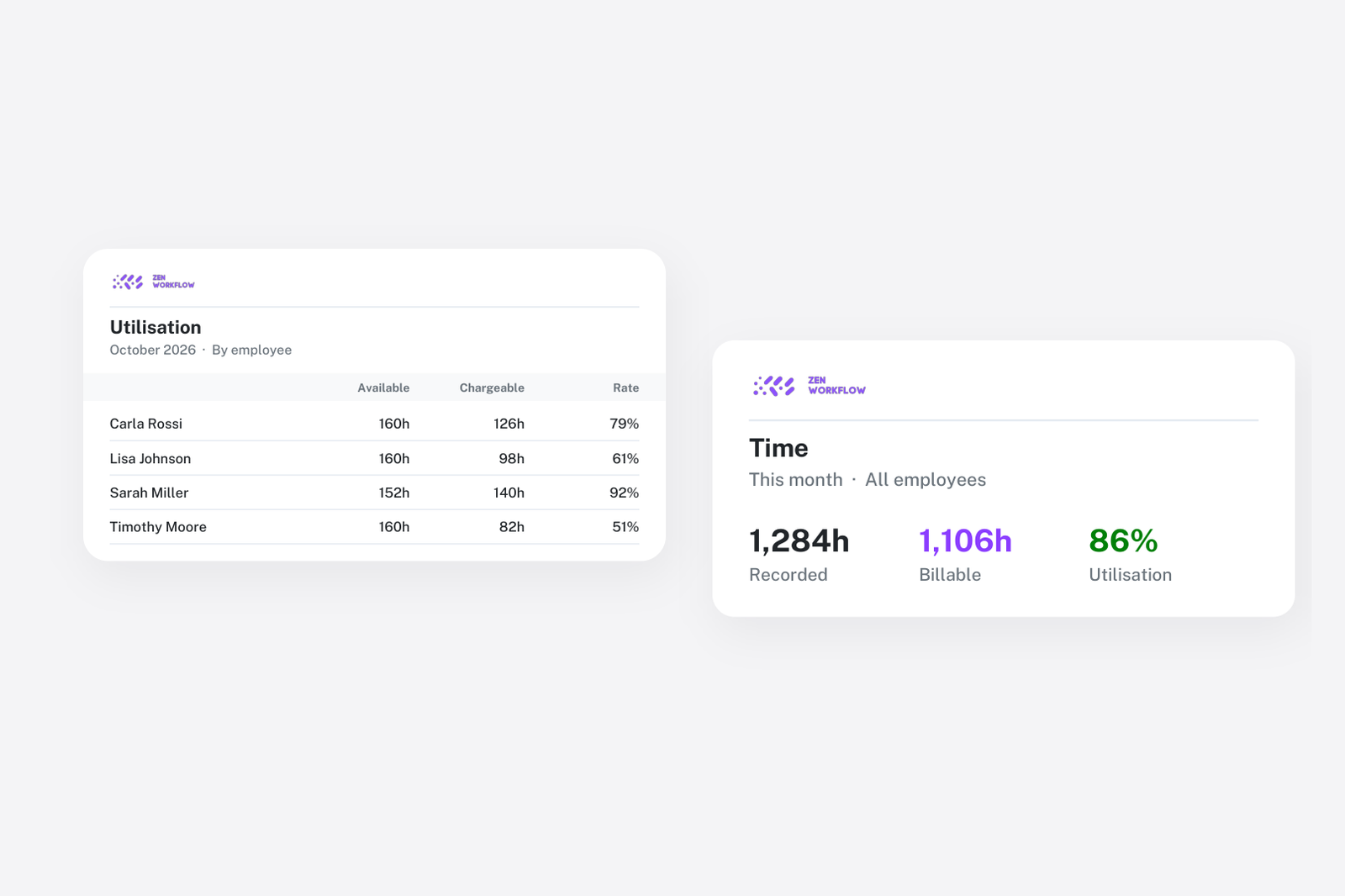
Utilisation rate is the percentage of a person's available working hours that is spent on chargeable client work. A member of staff with 1,700 available hours in a year who records 1,250 chargeable hours has a utilisation rate of 74 percent. The remainder went to training, administration, business development, internal meetings and the time that was worked but never recorded.
Key takeaways
- Utilisation rate = chargeable hours ÷ available hours × 100.
- Targets vary by role: 70 to 80 percent for staff, 55 to 70 for managers, 40 to 60 for partners who carry supervision and business development.
- Utilisation measures how busy people are. Realisation measures how much of that work is paid for. High utilisation with low realisation means the firm is busy doing unpaid work.
- Sustained utilisation above 90 percent is a capacity and burnout signal, not an achievement.
The formula
Utilisation rate = (chargeable hours ÷ available hours) × 100
Available hours are contracted hours less leave and public holidays. Some firms use total contracted hours as the denominator, which produces a lower figure. Either is fine if applied consistently, and the firm should state which it uses.
Chargeable hours are hours recorded against client work, whether or not they are eventually invoiced. Whether they are invoiced is the realisation rate.
A worked example
A senior accountant has 1,720 available hours after leave and holidays. She records 1,290 chargeable hours and 310 non-chargeable hours, and 120 hours are unaccounted for.
Utilisation rate = 1,290 ÷ 1,720 × 100 = 75 percent.
The 120 unaccounted hours are the interesting number. They are either time not worked, which is a scheduling question, or time worked and not recorded, which is a lost-fee question. Comparing recorded hours to contracted hours per person is the simplest test for under-recording.
What is a good utilisation rate?
| Role | Target range | Watch when |
|---|---|---|
| Junior and senior staff | 70 to 80% | Below 60% or above 90% |
| Managers | 55 to 70% | Below 50% |
| Partners | 40 to 60% | Above 70% sustained |
Below the range usually means not enough work, poor scheduling or time not being recorded. Above it for a sustained period means the firm is short of people and the work is being done in evenings, which ends in errors and resignations. For a partner, high utilisation often means too little time on the firm itself.
Utilisation versus realisation
The two numbers must be read together. A firm can have 85 percent utilisation and 72 percent realisation, which means people are busy and a quarter of their work is unpaid. The fix is pricing and billing, not more hours. A firm with 60 percent utilisation and 95 percent realisation has the opposite problem: the work it does is well priced and there is not enough of it. Both belong among the eight numbers a partner reviews monthly.
Utilisation and capacity planning
Utilisation by person and by month is the input to capacity planning. If staff utilisation is already at 80 percent and the firm is taking on a new client that needs 400 hours a year, the hours have to come from somewhere: a hire, a reduction elsewhere or evenings. Leave, deadlines and recurring work all affect available hours by month, which is why capacity is planned by month rather than by year.
How to improve utilisation
- Record time daily. Weekly timesheets lose a tenth of the hours.
- Review recorded hours against contracted hours per person each week.
- Schedule work against available hours by month, taking leave and deadlines into account.
- Move administration off chargeable staff where it can be automated or delegated.
- Do not chase utilisation above the target range. The cost is in quality and retention.
Measuring it in ZenWorkflow
ZenWorkflow records time daily against clients and workflows, holds leave and work schedules so available hours are known by person and month, and reports utilisation alongside realisation and unbilled work from the same data. The time tracking and leave management pages cover the two inputs, and the use case on planning team capacity shows how they combine.
Frequently asked
Should non-chargeable time be recorded? Yes. Without it the firm cannot distinguish time not worked from time not recorded, and cannot see where the non-chargeable hours go.
Is utilisation a fair measure of individual performance? On its own, no. A junior given no work has low utilisation through no fault of their own. Read it with workload, realisation and quality.
What is a chargeable hour on fixed-fee work? Time recorded against a fixed-fee engagement. It counts as chargeable for utilisation whether or not the fee covers it; the fee coverage is realisation.