What Is Enhanced Due Diligence (EDD)? When It Applies and What It Involves
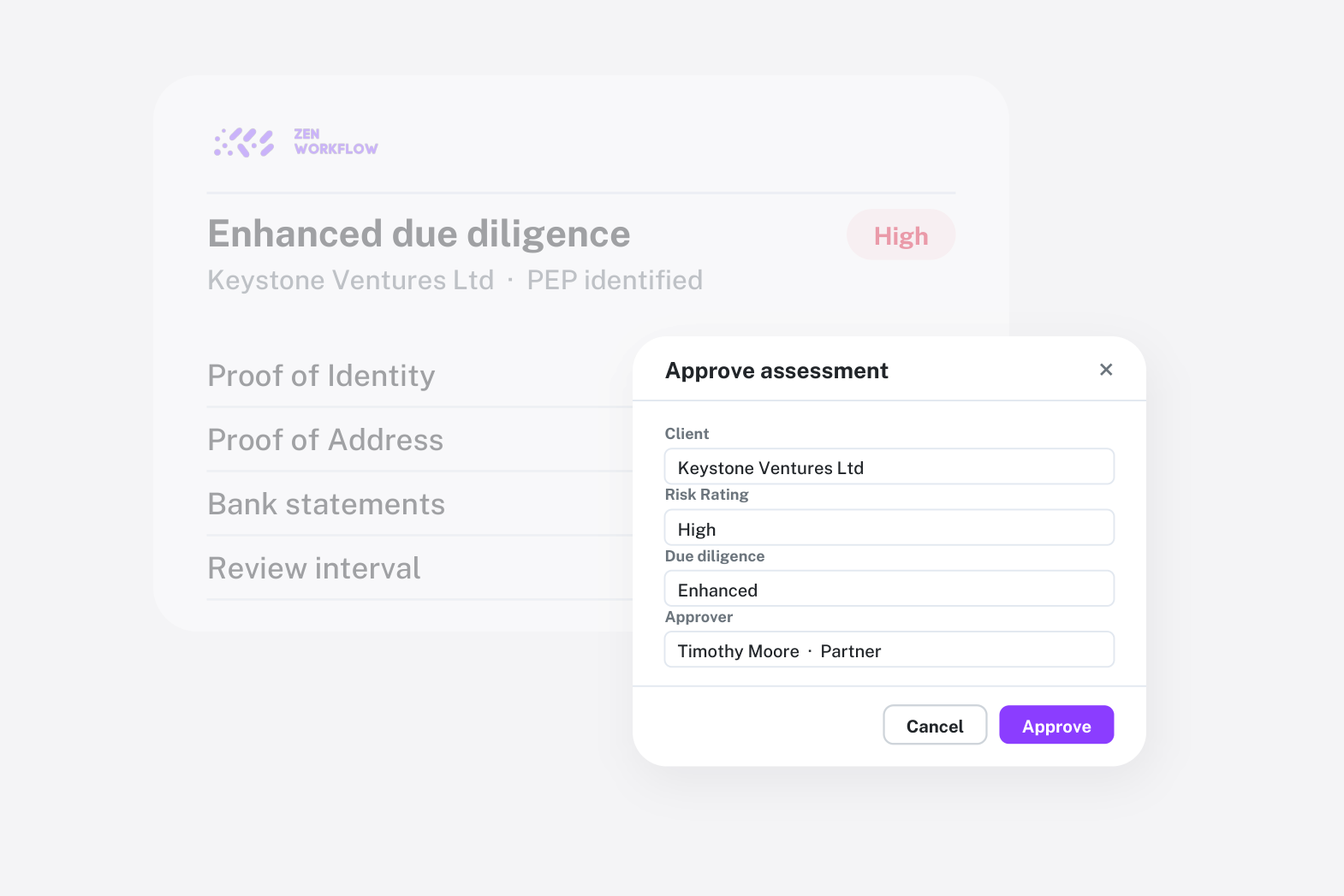
Enhanced due diligence is the additional set of customer due diligence measures a firm must apply where the risk of money laundering or terrorist financing is higher. Standard due diligence identifies and verifies the client and its beneficial owners and understands the relationship. Enhanced due diligence adds more information, scrutiny of the source of funds and wealth, approval by senior management and closer ongoing monitoring. It is mandatory in defined situations and required whenever the firm's own risk assessment rates a client as high risk.
Key takeaways
- Enhanced due diligence is mandatory for politically exposed persons and their family and close associates, for relationships involving high-risk third countries on the EU or UK list, and for complex or unusually large transactions with no apparent purpose.
- It is also required whenever the firm's own assessment rates a client high risk, whatever the reason.
- The core measures are: additional information on the client and beneficial owners, source of funds and source of wealth, senior management approval, and enhanced ongoing monitoring.
- The file must show the trigger, the measures taken, the approval and the monitoring plan. An unrecorded enhanced measure is, to an inspector, not taken.
When is enhanced due diligence required?
Politically exposed persons. Individuals who hold or have held a prominent public function, domestically or abroad, together with their family members and known close associates. Enhanced measures continue for at least twelve months after the person leaves office, longer where the risk warrants.
High-risk third countries. Clients established in, or transactions involving, countries identified by the European Commission or the UK as having strategic deficiencies in their anti-money-laundering regimes. The lists are updated periodically and the firm's screening needs to follow them.
Complex or unusual transactions. Transactions that are unusually large, have an unusual pattern or no apparent economic or lawful purpose. The firm examines the background and purpose and records its findings.
High-risk by the firm's own assessment. Any client whose rating under the firm's methodology is high, for example because of ownership complexity, a cash-intensive business, a high-risk sector or a non-face-to-face relationship through an intermediary. What a client risk assessment must contain covers the rating.
Other cases set by the rules. Correspondent relationships for financial institutions and certain other situations defined by national rules. For most professional firms the four categories above cover it.
What does enhanced due diligence involve?
Additional information. More detail on the client's business, its ownership and control structure, the reasons for the intended relationship and the expected nature and volume of activity. For beneficial owners, additional identification and verification beyond the standard set.
Source of funds and source of wealth. Source of funds is where the money for this relationship or transaction comes from: a sale, a salary, a loan. Source of wealth is how the person came to have their overall wealth: a business built over twenty years, an inheritance, an investment career. Both are documented with evidence proportionate to the risk, not a client's assurance alone. For politically exposed persons both are mandatory.
Senior management approval. A partner or the compliance officer approves establishing or continuing the relationship, with the approval recorded by name and date. For politically exposed persons this is an explicit requirement.
Enhanced ongoing monitoring. More frequent periodic review, usually annual, closer scrutiny of transactions and a lower threshold for escalation. The monitoring plan is written down so that it can be followed.
What goes on the file?
- The trigger: which category made enhanced due diligence necessary
- The additional information obtained and the documents supporting it
- The source of funds and source of wealth findings, with evidence
- The senior approval, by name and date
- The review interval and monitoring measures applied
- The date of each subsequent review and its outcome
Inspectors look for the chain from trigger to measures to approval. Enhanced due diligence that was done but not recorded does not count.
Enhanced versus simplified due diligence
Simplified due diligence is the reduced set of measures permitted for clients the firm's assessment and the rules treat as low risk, for example certain regulated entities or listed companies. It is a permission, not a default, and it must be justified on the file. Enhanced due diligence is the opposite end of the same scale. Standard due diligence is everything in between, and most clients.
Doing it in ZenWorkflow
ZenWorkflow flags clients whose rating or screening results require enhanced measures, records source of funds and wealth documents against the client and each beneficial owner with expiry dates, routes the assessment for approval through the firm's approval layers with the approver and date recorded, and sets a shorter review interval from the high-risk rating. The AML and KYC module page describes the process, and running periodic reviews covers the monitoring side.
Frequently asked
Is every high-risk client subject to enhanced due diligence? Yes. Whether the high rating comes from a mandatory category or from the firm's own assessment, enhanced measures follow.
Is a domestic politically exposed person treated the same as a foreign one? Under current EU and UK rules both are politically exposed persons and both require enhanced measures, with the extent of the measures proportionate to the risk.
How much source of wealth evidence is enough? Enough to make the explanation credible and consistent with the person's profile. A business owner's accounts, a property sale completion statement or an inheritance document. A written assurance alone is not evidence.
Who can give senior management approval? A person with sufficient seniority and knowledge of the firm's risk exposure, usually a partner or the compliance officer, as defined in the firm's policy.