What Is Lock-Up? Definition, Formula and Targets for Professional Firms
Lock-up is the total number of days between a firm doing a piece of work and receiving payment for it. It is the sum of two periods: the time the work sits unbilled as work in progress, and the time the invoice sits unpaid as a debtor. A firm with 45 days of work in progress and 50 days of debtors has a lock-up of 95 days, which means roughly a quarter of its annual fees are owed to it at any moment.
Key takeaways
- Lock-up = work in progress days + debtor days.
- It measures how much of the firm's revenue is tied up in unbilled and unpaid work, expressed in days of fee income.
- A target under 75 days is reasonable for most professional firms. Over 100 is a cash-flow problem waiting for a slow quarter.
- Reducing lock-up by 30 days on one million of annual fees releases roughly 80,000 of cash, once, and keeps it released.
The formula
Work in progress days = (unbilled time at standard value ÷ annual fee income) × 365
Debtor days = (receivables outstanding ÷ annual fee income) × 365
Lock-up = work in progress days + debtor days
Both components use the same denominator, annual fee income, so they can be added. Some firms use the standard value of recorded time as the denominator for the first and invoiced fees for the second. Either works, provided the firm is consistent.
A worked example
A firm has annual fee income of 1,200,000, unbilled time at standard value of 150,000 and receivables of 180,000.
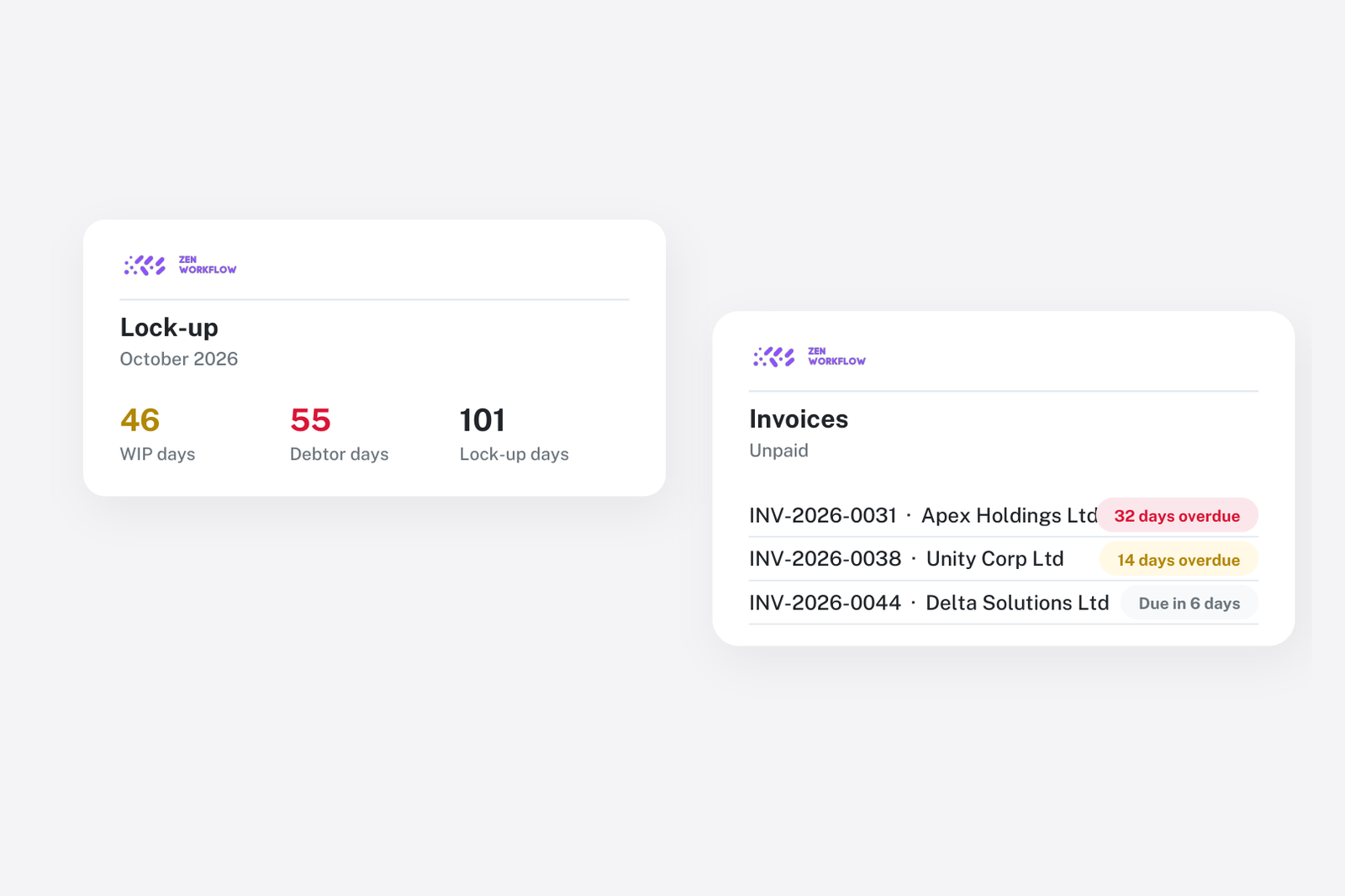
Work in progress days = 150,000 ÷ 1,200,000 × 365 = 46 days
Debtor days = 180,000 ÷ 1,200,000 × 365 = 55 days
Lock-up = 101 days
A hundred and one days of fees, about 330,000, is owed to the firm at any time. If it reduced work in progress days to 25 by billing at the end of each engagement rather than at the end of the quarter, and debtor days to 40 by chasing on day 31, lock-up would fall to 65 days and roughly 118,000 of cash would arrive that would otherwise be sitting in unbilled and unpaid work.
What is a good lock-up?
| Lock-up | Reading |
|---|---|
| Under 60 days | Excellent. Billing on completion and prompt collection. |
| 60 to 75 days | Good. Typical of disciplined firms. |
| 75 to 100 days | Average. One of the two components needs attention. |
| Over 100 days | A quarter of fees or more is tied up. Cash flow depends on timing. |
Audit firms tend to run higher work in progress days because engagements are long. Law firms with litigation work carry long work in progress by nature. The useful comparison is the firm against its own history, by partner and by service.
Why does lock-up grow?
Late billing. Invoices raised at quarter end rather than at the end of the engagement. Thirty days of work in progress is added for no reason other than habit.
Fee uncertainty. The partner is not sure what to bill, so the time sits. Usually a scoping problem. See engagement letters and scope creep.
No chasing routine. Overdue invoices are chased when someone notices. Debtor days drift up five at a time.
Clients in difficulty. A rising debtor-days trend is often the first sign that a significant client is struggling.
How to reduce lock-up
- Bill on completion of each engagement, or monthly for ongoing work, never only at period end.
- Make unbilled time visible by client before the invoice is raised, so nothing is forgotten.
- Set a chasing routine: reminder on the due date, a call at 14 days overdue, a partner call at 30.
- Offer direct debit or card payment for recurring fees.
- Review work in progress ageing and the aged debtor list monthly, by partner, among the eight monthly numbers.
Lock-up and realisation rate
Lock-up measures how long the firm waits for its fees. Realisation rate measures how much of the work is paid for at all. Long work in progress feeds low realisation, because old time is written off rather than billed, so the two numbers usually move together.
Measuring it in ZenWorkflow
ZenWorkflow holds time, invoices and receipts on the same client, so work in progress ageing, debtor ageing and lock-up come out of the reports without assembly. Unbilled time appears on the client's billing page with its age, and overdue invoices are visible by client and by partner. The billing and invoicing page describes the invoice side.
Frequently asked
Is lock-up the same as days sales outstanding? Days sales outstanding is the debtor-days component only. Lock-up adds the unbilled work in progress in front of it, which is the part professional firms most often ignore.
Should work in progress be valued at standard rates or expected billing? Standard rates for consistency. If the firm expects to write off part of it, that is a realisation problem to measure separately.
How often should lock-up be measured? Monthly, with the two components shown separately so the firm can see which one moved.