What Practice Management Software Costs, and What It Should Return
Partners compare practice management software by the price per user per month because that is the number on the pricing page. It is the right number to compare between vendors and the wrong number for deciding whether to buy at all. The subscription for a ten-person firm is a rounding error against the fees the firm writes off in a quarter. The question is whether the software recovers them.
This article sets out the full cost and a method for estimating the return, so the decision is a business case rather than a line in the budget.
The cost
Subscription. Almost always per user per month, sometimes with tiers by feature. Three things change the real number: what counts as a user, whether compliance or billing features are an add-on, and what the price does at renewal. Ask for a two-year quote in writing. ZenWorkflow's pricing is per user with AML and KYC included in the Practice + AML plan.
Implementation. Some vendors charge an onboarding fee, some do not. Either way the firm's own time is the larger cost: a manager and a partner for part of two to four weeks to configure services, templates and permissions.
Migration. Getting the client list, the services, the open work and the documents in. The cost depends entirely on the state of the data. A clean client list imports in a day. A client list that lives in three systems with different spellings takes a month, and that month is the real reason implementations stall.
Training. Half a day for staff, more for the people who will administer it. Budget for a second session a month in, when the questions are real.
The parallel period. For a month or two the firm runs the old and new systems together. This is unavoidable and should be planned rather than resented.
For a ten-person firm the honest total for year one is the subscription plus somewhere between two and five weeks of senior time. Year two is the subscription.
The return
The return comes from five places. Estimate each with the firm's own numbers; a vendor's calculator uses averages that may not be yours.
Recovered fees. The largest and the least discussed. If the firm's realisation rate is 82 percent and disciplined billing takes it to 88, that is six percent of fee income. For a firm billing a million that is 60,000 a year, and it dwarfs everything below. How to measure the leak is covered separately.
Admin time. The hours spent creating recurring jobs by hand, chasing status by email, building the month-end billing spreadsheet and reconstructing the deadline list. Count them for a month. Two hours a day across a firm is common, and that is a quarter of a full-time salary.
Faster billing. Invoices raised at the end of the engagement rather than at the end of the quarter. Shortening the gap between work and invoice by thirty days on a million of fees releases roughly 80,000 of working capital once, and keeps it released.
Compliance. The cost of an AML review cycle run from a spreadsheet, the cost of a failed inspection and the cost of the compliance officer's time reconstructing files. Hard to put a number on until the inspection letter arrives, at which point it is easy.
Capacity. The engagements the firm could take on with the same staff if the coordination overhead fell. This is the number that moves firms from cost-saving to growth, and it is the one a case study can show better than an estimate.
A worked business case
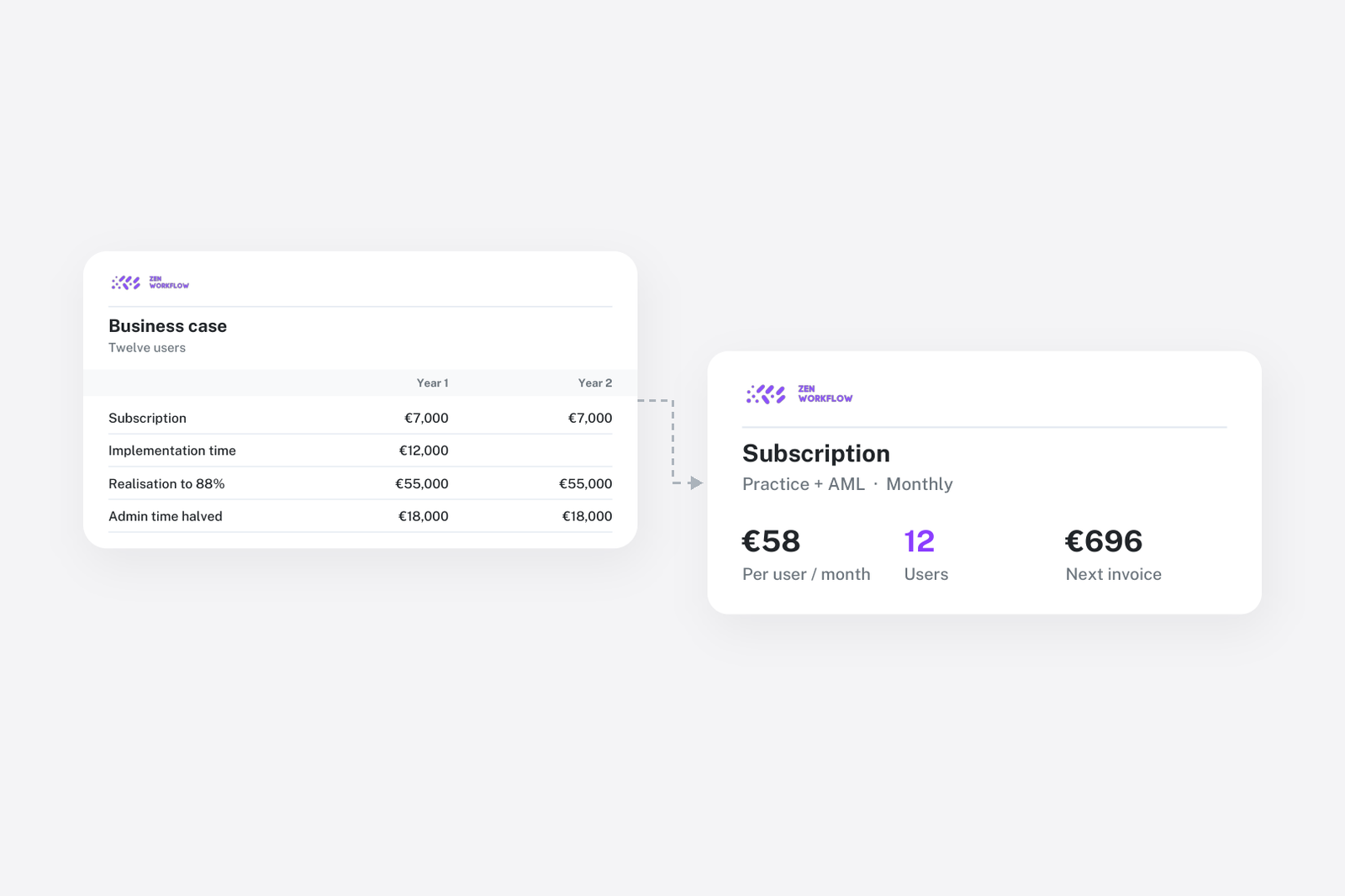
A twelve-person firm, fee income of 1.1 million, realisation 83 percent, two hours a day of firm-wide admin on coordination, invoices raised on average 45 days after work completes.
| Year one | Year two | |
|---|---|---|
| Subscription, 12 users | 7,000 | 7,000 |
| Senior time on implementation and migration | 12,000 | 0 |
| Cost | 19,000 | 7,000 |
| Realisation to 88 percent | 55,000 | 55,000 |
| Admin time halved | 18,000 | 18,000 |
| Billing gap cut to 20 days, working capital released | 75,000 once | 0 |
| Return | 148,000 | 73,000 |
The subscription figure is illustrative; use the vendor's quote. The point is the shape: the return is an order of magnitude larger than the cost, and most of it comes from fees the firm is already earning and not collecting.
Checking that it arrived
A business case that is never revisited is a hope. Three numbers, measured before and twelve months after:
- Realisation rate, by service
- Days from work completion to invoice
- Hours of admin per week, from a one-week sample
If none of them moved, either the software is not being used or it was the wrong software. Both are fixable, and neither is found without measuring.
When not to buy
A firm under five people with one partner who knows every client may not recoup the implementation time. A firm whose client data is in such disarray that migration would take a quarter should clean the data first, because the software will not. A firm that is buying because a competitor did, with no process in mind that it wants to change, will implement it badly and conclude software does not work.
Doing it in ZenWorkflow
ZenWorkflow is priced per user with billing, time, workflows and client management in every plan and AML and KYC in the Practice + AML plan. Implementation is a client-list import, a set of workflow templates and a permissions setup; most firms go live in a few weeks. The case study shows what a 22-person audit firm did with it, the comparison pages set it against the alternatives, and the buyer's guide covers the questions to ask before choosing anything.
Frequently asked
Is per-user pricing fair for part-time staff? Ask the vendor. Some count active users monthly, some count seats. The difference matters for a firm with seasonal staff.
How long until the return shows? Admin savings within a quarter. Realisation improvements within two quarters, once billing is being raised from the ledger. Capacity gains within a year.
Should we pay for implementation help? If the client data is messy or the firm has no one with time to own the rollout, yes. A stalled implementation costs more than any onboarding fee.