Client Onboarding Checklist for Accounting, Audit and Law Firms
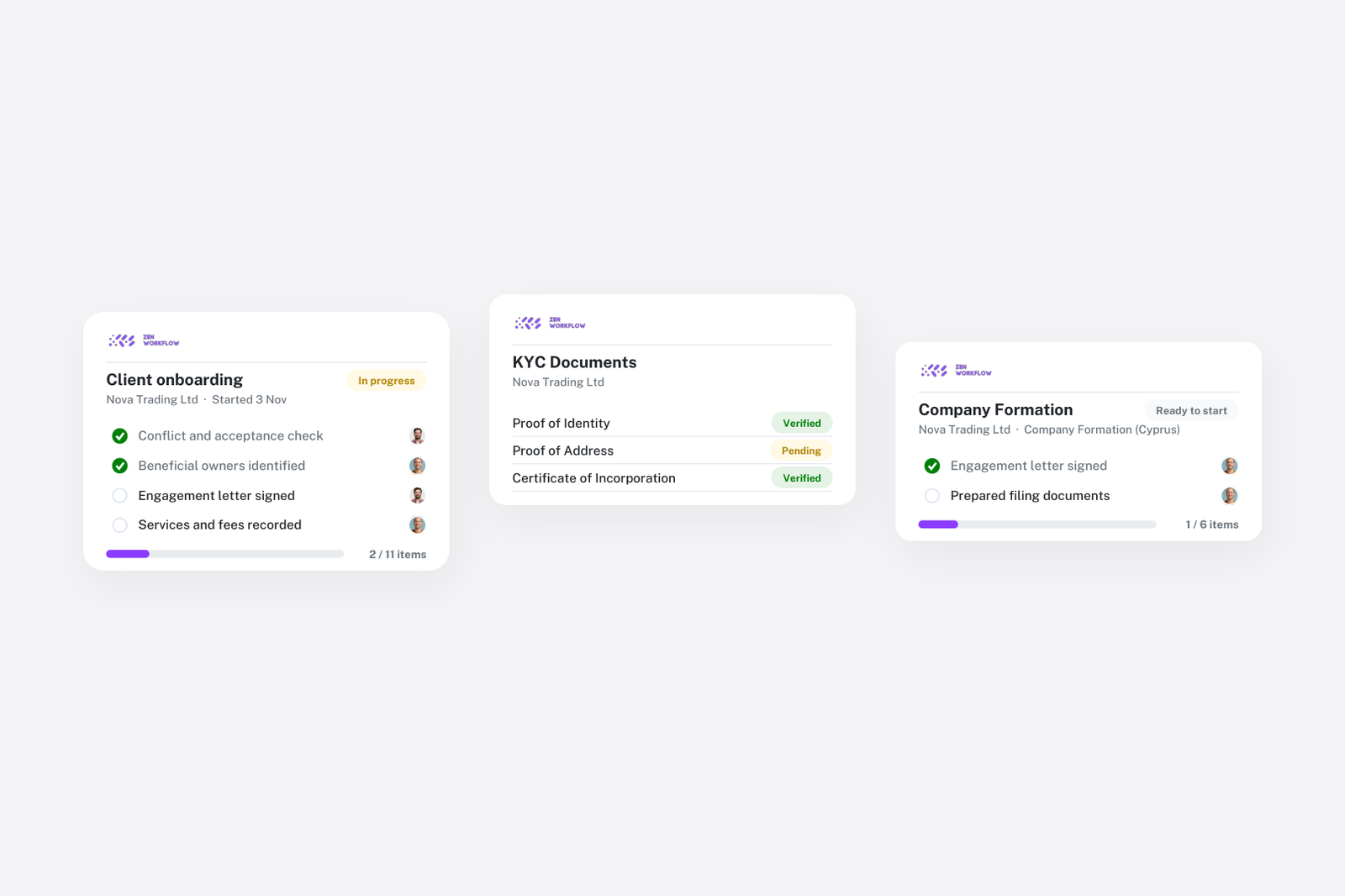
The first month with a new client sets the pattern for the whole relationship. Onboard well and the firm has a signed scope, a complete KYC file, a fee that was agreed rather than assumed and a deadline list that nobody has to reconstruct. Onboard badly and the same client produces a scope dispute in month three, a compliance gap at the next review and a write-off at the first invoice.
This is the checklist we use. It is written for a firm that takes on companies as clients, which is most accounting, audit, legal and corporate-services work, but the individual-client version is the same list with fewer people on it.
Before accepting
1. Conflict and acceptance check. Confirm the firm can act: no conflict with an existing client, no reason under the firm's acceptance policy to decline, and the engagement is within the firm's competence. Record who made the decision and when. Regulators ask for this, and so do professional indemnity insurers.
2. Identify the people behind the entity. Directors, shareholders above the threshold your policy sets, ultimate beneficial owners and anyone with signing authority. Draw the ownership chain to the natural persons at the top. For a group, do it for every entity you will act for. This list is the input to everything that follows.
3. Collect identity and address evidence. For every person identified: a certified identity document, proof of address and, where your policy requires it, a source of funds or wealth statement. Record the document type, number, issuing country and expiry date, because expiry is what triggers the next refresh.
4. Screen every person and the entity. Sanctions, politically exposed person and adverse media checks on each individual and the company. Keep the result against the person, not in a folder named after the company, so a new director later is visibly unscreened.
5. Complete the risk assessment. Score the client against your firm's risk factors: customer type, jurisdiction, industry, products and services, delivery channel, ownership complexity. Record the rating, the reasoning and any override. Set the review date from the rating. The contents of a client risk assessment are covered separately.
Agreeing the work
6. Engagement letter. Scope, responsibilities, fees, payment terms, limitation of liability and the process for work outside scope. Signed before work starts, filed against the client. If the firm does not have a template per service, this is the moment to make one. Engagement letters and scope creep is covered in detail elsewhere.
7. List the services and the fees. Each service the client has engaged you for, with its fee basis: fixed, hourly, per unit or retainer. This list is what recurring work and billing are built from. It should be a record on the client, not a paragraph in the letter that someone has to re-read.
8. Record the deadlines. Filing dates, year end, VAT periods, licence renewals, annual return date, anything with a regulator or a penalty attached. Most of these follow from the year end and the jurisdiction, and a good system will derive them.
Setting up the file
9. Create the client record once. Name, registration number, addresses, contacts, year end, tax identifiers and the custom fields your firm tracks. If the record exists in four systems it is wrong in at least one of them.
10. Store the documents where the work happens. Engagement letter, incorporation documents, KYC evidence, prior-year accounts. A client folder that mirrors the client record, with the compliance documents tagged with their expiry dates.
11. Launch the first workflow. Create the first engagement from a template, assign it, set its due date and let the recurring ones schedule themselves. A client with services and no workflow is a client the firm has agreed to serve and not yet started to.
The onboarding file, in one view
| Item | Who | Evidence |
|---|---|---|
| Acceptance decision | Partner | Dated note |
| People identified | Staff | Ownership chart |
| ID and address | Staff | Documents with expiry |
| Screening | Compliance | Result per person |
| Risk assessment | Compliance, partner | Rating, reasoning, review date |
| Engagement letter | Partner | Signed copy |
| Services and fees | Partner | Service list |
| Deadlines | Manager | Deadline list |
| Client record | Staff | One record |
| Documents | Staff | Client folder |
| First workflow | Manager | Live engagement |
What goes wrong
The usual failure is not that a step is skipped. It is that the steps happen in different systems and nobody can see that one is missing. The engagement letter is in email, the KYC file is on a drive, the services are in the partner's head and the deadlines are in a calendar. Each is complete on its own. Together they are a client with a signed letter, no risk assessment and an invoice that nobody agreed.
The fix is to make the client record the place where every item is either present or visibly absent.
Doing it in ZenWorkflow
ZenWorkflow puts all eleven items on the client record: the people and their documents with expiry dates, screening results per person, the risk assessment with its review date, the services with their fee basis, the deadlines and the workflows that come from them. A client with a missing item shows as incomplete in the compliance views, so the gap is found by the firm rather than by the regulator. The use case on automating client onboarding walks through the sequence, and the client management page describes the record itself.
Frequently asked
How long should onboarding take? For a straightforward company with local owners, a week from first contact to first workflow. Complex ownership or overseas owners take longer, almost entirely on document collection.
Do we need a risk assessment for every client? If the firm is subject to anti-money-laundering regulation, yes, before the business relationship begins, and a reassessment on the schedule your policy sets.
What if the client will not provide documents? Then the firm cannot complete due diligence and should not start the work. That is uncomfortable, and it is the rule.